
In this article
Why in the News
An article published on 26 November 2026 argues that unequal access to public toilets limits people's social and economic participation. Using World Toilet Day on 19 November as the hook, it asks whether the Swachh Bharat Mission has ensured clean, safe, functional and dignified public toilets for all. The authors say this is part of the fundamental rights under Article 21 of the Constitution. [1]
A Kolkata survey by Sabar Institute and Azad Foundation (executive brief dated 29 June 2026) covers the same issue. This article uses that brief for the figures below. [2]
What the Survey Says
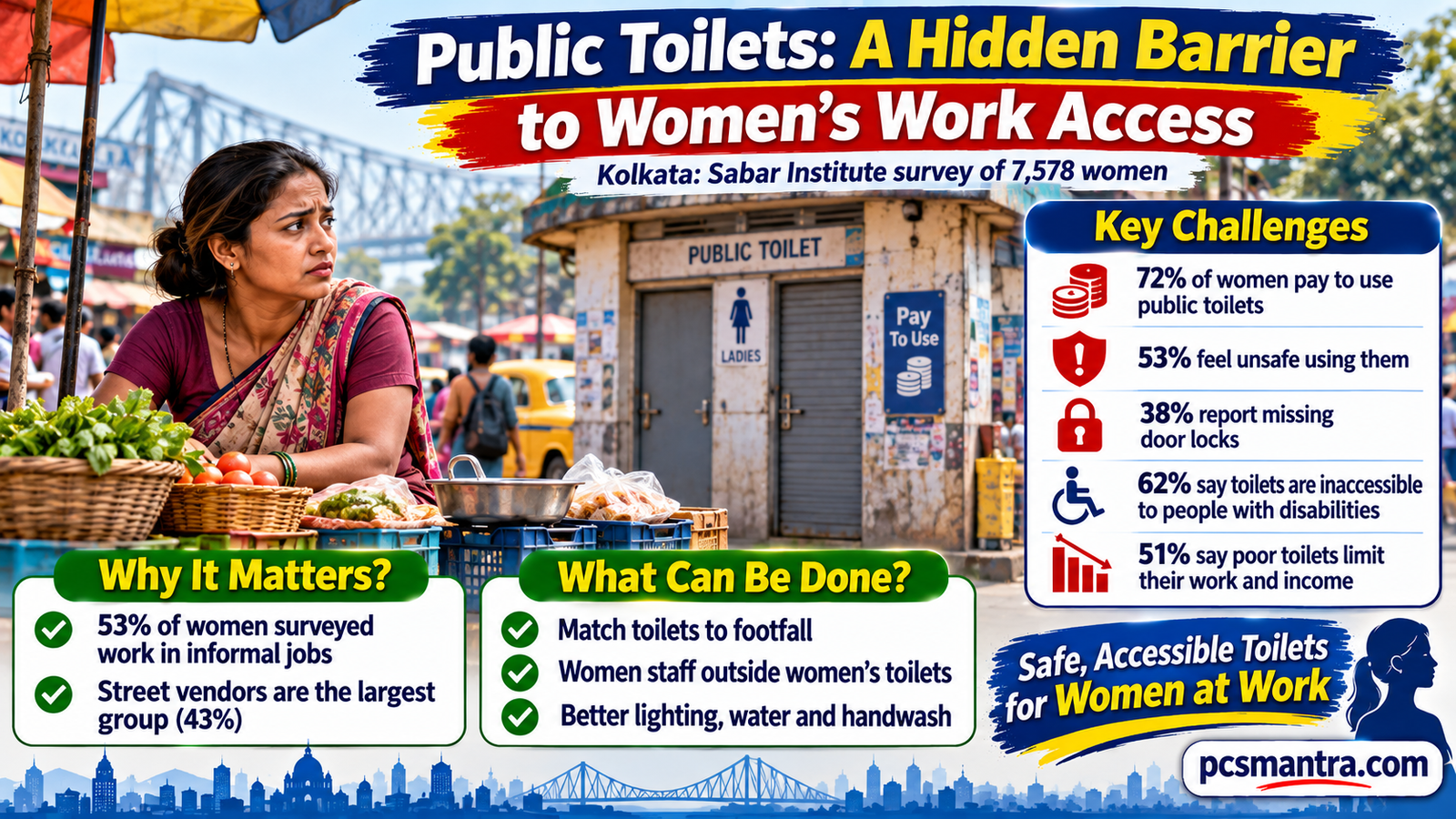
The survey covered 7,578 cis women and 38 trans or queer persons. Among the women respondents, 53% worked in the informal sector. The largest group was street vendors (43%), followed by retail salespersons (15.7%) and domestic workers (13.8%). [2]
- Payment: 72% of women pay to use public toilets; the cost can take up to about 10% of their daily income.
- Safety: 53% felt unsafe using public toilets; 52% of trans or queer respondents reported harassment; 38% reported missing door locks.
- Disability access: 62% said toilets are not accessible to persons with disabilities.
- Hygiene: 30% rated toilets "dirty" or "very dirty". The brief records a lack of handwashing and sanitary-napkin disposal. Many women and queer persons drink less water to avoid using public toilets.
- Effect on work: 51% believe inadequate, non-inclusive or poorly maintained toilets limit their ability to work outside the home and their income. [2]
| Station | Daily footfall | Men | Women | Disabled |
|---|---|---|---|---|
| Howrah | Over 9 lakh | 33 | 19 | 5 |
| Sealdah | 15 to 18 lakh | 23 | 24 | 3 |
The table counts toilet units, as the brief reports them. It shows how few facilities there are in proportion to crowds, especially at Sealdah, where 15 to 18 lakh daily passengers share 50 units in all (our sum of 23 + 24 + 3). [2]
A Toilet Is a Work Facility
A street vendor or domestic worker has no fixed office, so every working hour is spent on the road and in the market. When there is no safe, free or cheap and clean toilet there, she must stop work, walk far or pay every day. That is why the survey makes the toilet a question of income and mobility as well as health and dignity. Mobility here means the ease of getting between home and work.
Construction Figures Versus Usability
According to PIB, as on 19 November 2025, 6,38,826 community and public toilets had been built under Swachh Bharat Mission-Urban (SBM-U) against a target of 5,07,587. Individual household toilets built were 63,74,355 against a target of 58,99,637. [3]
These are construction numbers. They do not say whether the toilets work, are safe, have latches, or are enough for women and trans persons. SBM-U 2.0 is described as adding focus on the functionality and maintenance of community and public toilets. [4]
Limits
The survey covers only Kolkata and its respondents are mainly working women, with street vendors the largest group. It is therefore not a representative sample of India. The 10% income figure describes an upper case ("can consume"), not an average. A national conclusion needs evidence from other cities.
Way Forward
- Facilities in proportion to footfall: The number of toilets at stations, markets and bus stands should follow the number of users.
- Safety: Women staff outside women's toilets and proper lighting.
- Monitoring: An independent monitoring committee.
- Basics: Water, handwashing, sanitary-napkin vending machines and disposal.
- Inclusion: Adequate facilities for cis women and trans or queer persons. The brief notes that lactation points and diaper-changing stations are generally unavailable. [2]
Mains Practice Questions
Question 1. How does unequal access to public toilets affect women's economic participation? Suggest measures to move the Swachh Bharat Mission from "construction" to "usability". (250 words, 15 marks)
Answer outline
Introduction:
Treat the toilet as a facility for income and mobility as well as health; mention urban informal women workers.
Body:
Payment burden, insecurity, lack of access and work interruption; the Kolkata survey as an example, with its limits.
Construction figures (SBM-U) versus working, safe and inclusive facilities.
Measures: facilities in proportion to footfall, safety, independent monitoring, water and hygiene, inclusive design.
Conclusion:
The test of the mission should be usable toilets, not a count of toilets.
Question 2. Why should public toilets be treated as a "basic workplace facility" for women in the urban informal sector? Discuss. (150 words, 10 marks)
Answer outline
Introduction:
State the role of public space where there is no workplace.
Body:
Working hours are spent on roads and markets; without toilets, time and income are lost.
Safety and dignity, and the link to Article 21.
Conclusion:
The quality of public facilities decides the participation of informal women workers.
Sources
- The Hindu: article on the economic impact of unequal toilet access, 26 November 2026 (paywalled, read only in part)
- Sabar Institute and Azad Foundation: executive brief, 29 June 2026
- PIB: status of SBM-U, figures as on 19 November 2025
- PIB: SBM-U 2.0 focus on functionality and maintenance of community and public toilets
Frequently Asked Questions (FAQ)
How many people did the Kolkata survey cover?
7,578 cis women and 38 trans or queer persons. Among the women, 53% worked in the informal sector.
Does the survey apply to all of India?
No. It is a Kolkata survey and its sample is mainly working women.
What do the SBM-U construction figures show?
According to PIB, as on 19 November 2025, 6,38,826 community and public toilets were built against a target of 5,07,587. These are construction counts, not measures of usability.
Download this article: PDF