
News reference: 25 November 2026
Published: 28 November 2026
Prelims: Science and technology, crewed spaceflight and space cooperation
In this article
Why in the news
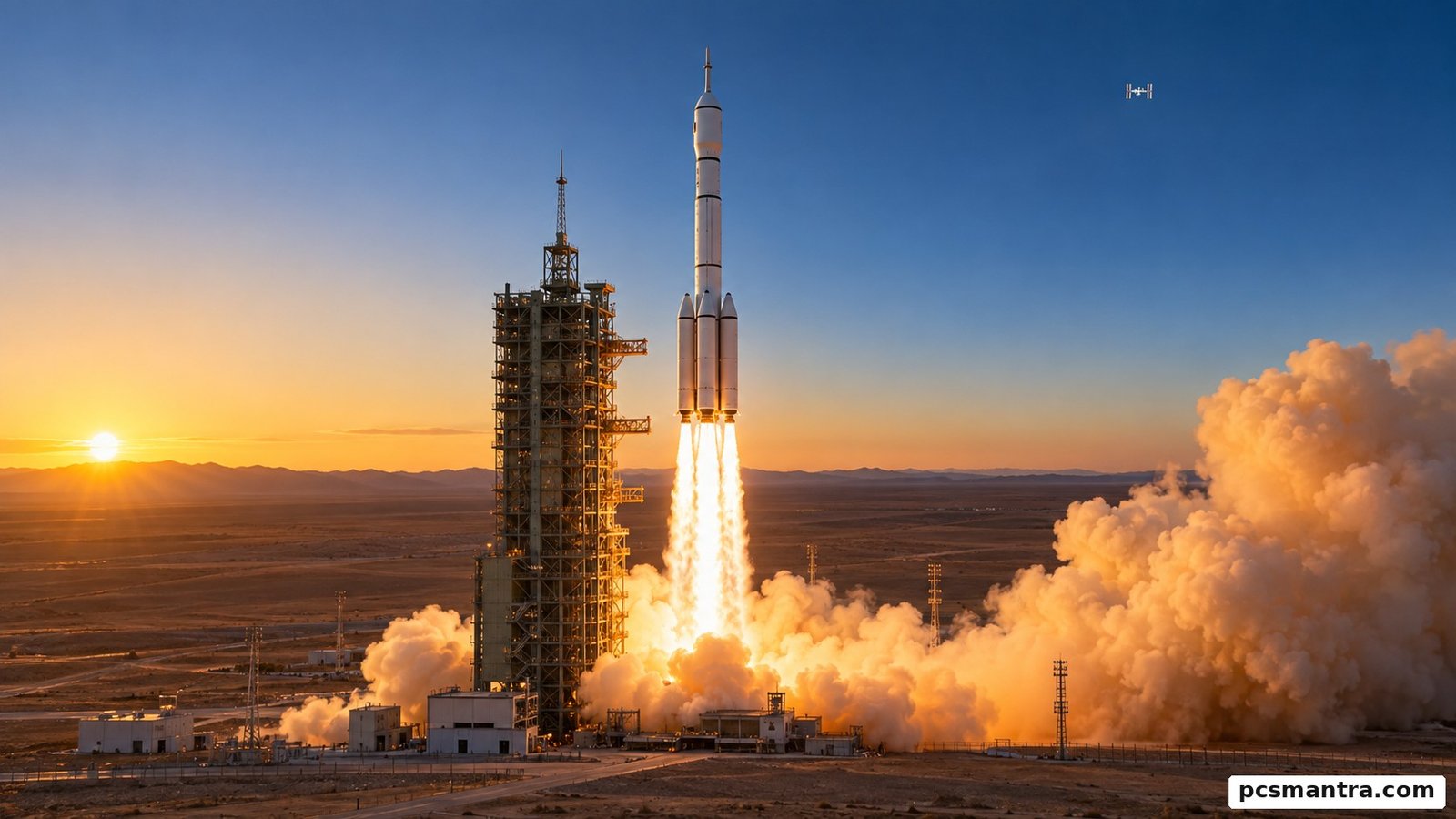
Shenzhou-24 lifted off on a Long March-2F rocket at 8:18 a.m. Beijing time on 25 November 2026. The spacecraft separated from the rocket about 10 minutes later, and the China Manned Space Agency (CMSA) declared the launch a "complete success". The same day, at 11:56 a.m., it made a fast automated docking with the front port of Tiangong's core module Tianhe; the whole process took about three and a half hours. At 2:35 p.m. Beijing time the Shenzhou-23 crew opened the hatch, in the first Chinese-foreign "space handshake".
The crew comprises commander/pilot Tang Hongbo and flight engineer Wu Yi (both Chinese) and Pakistani astronaut Muhammad Zeeshan Ali. Ali is 40, a former Pakistan Air Force pilot, and began training on 24 April 2026.
Basics: Shenzhou: China's crewed spacecraft that ferries crews to and from Tiangong. Tiangong: China's space station; its core module Tianhe went up in 2021 and the two lab modules Wentian and Mengtian joined in 2022. Docking: the joining of two spacecraft in orbit. Payload specialist: a crew member trained mainly for scientific experiments, not for flying the craft. Orbital vs suborbital flight: an orbital flight reaches the speed and height needed to circle the Earth; a suborbital flight reaches the edge of space and returns without completing an orbit.
What "first Pakistani" means here
Zeeshan Ali is the first Pakistani to reach orbit and the first to reach a space station. In October 2023, Pakistani-origin Namira Salim flew on Virgin Galactic's Galactic 04 mission (6 October 2023), a suborbital flight. That flight did not reach Earth orbit. For the exam, keep the two apart: Salim's 2023 flight was suborbital; Ali's flight is Pakistan's first orbital flight and the first foreign-astronaut flight to Tiangong.
Crew and mission
| Point | Detail |
|---|---|
| Launch | 25 November 2026, 8:18 a.m. Beijing time, Jiuquan Satellite Launch Center, Long March-2F rocket |
| Docking | Same day, 11:56 a.m. (Beijing time), front port of the Tianhe core module; automated, about 3.5 hours |
| Crew | Tang Hongbo (commander/pilot), Wu Yi (flight engineer) - China; Muhammad Zeeshan Ali - Pakistan |
| Role of the Pakistani member | Former Pakistan Air Force pilot; trained as a scientific payload specialist; will run the in-orbit photosynthetic cyanobacteria experiment |
| Distinction | First foreign crew member on Tiangong; first Pakistani in orbit; first joint Chinese-foreign flight of China's manned programme |
| Duration and return | Tang Hongbo and Wu Yi stay about six months. Ali returns with two Shenzhou-23 crew members aboard the Shenzhou-23 spacecraft. Shenzhou-23 astronaut Zhu Yangzhu remains on the station to complete a year-long stay experiment |
| Experiments | More than 90 experiments and technology tests: space life sciences, material science, microgravity fluid physics and combustion, fundamental physics, space medicine and new space technologies |
| China-Pakistan projects | Four joint cooperative projects |
Four key experiments
According to the Chinese Academy of Sciences (CAS) account, four experiments stand out.
- Cyanobacteria: testing "green microfactories" for oxygen regeneration and biomanufacturing; Ali will run it for regenerative life support.
- 32 quinoa seed samples: exposed outside the station to study stress tolerance and screen germplasm.
- Multilayer graphene-based hybrid composite shielding: about one year of exposure outside the station.
- Heat-triggered self-healing carbon fibre composites: materials that repair themselves when heated, with nearly one year of exposure.
How a Pakistani got aboard: the 2025 agreement
This flight was not built in a day. According to Pakistan's national space agency SUPARCO, on 28 February 2025 SUPARCO and the CMSA signed a cooperation agreement under which two Pakistani astronauts would train at the Astronaut Center of China; one was to be prepared as a scientific payload specialist, with selection to be completed by 2026. Zeeshan Ali's flight is the outcome of that process.
China-Pakistan space cooperation is not new:
- 1990: Pakistan's first experimental satellite, Badr-1, was launched on 16 July 1990 on a Long March-2E from Xichang.
- 2024: Pakistan's iCUBE-Qamar cubesat flew on China's Chang'e-6 mission.
- April 2026: the Pakistani remote-sensing satellite PRSC-EO3 was launched on a Long March-6.
- 2026: the 75th anniversary of China-Pakistan diplomatic relations (established 21 May 1951).
Shenzhou-24 is the crewed-flight rung of this ladder.
What it means for India
Strategic reading: China is turning its station into a platform for international partnership. The first foreign crew presence on Tiangong, compared with the role of the International Space Station (ISS), shows China's "space diplomacy". Only three countries operate human-rated spacecraft so far: the US, Russia and China.
The neighbourhood dimension: China-Pakistan cooperation now extends beyond the military sphere into high-technology domains, namely satellites and crewed spaceflight. For India, it signals technological-strategic closeness next door.
Comparison point: India's own crewed programme, Gaganyaan, is in preparation. In December 2025 the government told Parliament that the first crewed lunar mission is tentatively targeted by 2040, and that Chandrayaan-4, Chandrayaan-5 (ISRO-JAXA LUPEX), Gaganyaan follow-on missions, the first module of the Bharatiya Antariksh Station (BAS-1), the NGLV and a Third Launch Pad are approved. For the date of Gaganyaan's crewed flight, refer to the government's recent announced timelines. A balanced comparison of the two countries' crewed-flight plans can be used in Mains answers.
Exam relevance
Prelims facts: the mission's name (Shenzhou-24), date (25 November 2026), rocket (Long March-2F), launch centre (Jiuquan), station (Tiangong, core module Tianhe), the first foreign visitor (Pakistan's Muhammad Zeeshan Ali), the SUPARCO-CMSA agreement (28 February 2025), and the difference between Namira Salim's 2023 suborbital flight and Ali's orbital flight - all directly askable.
Mains angle: space diplomacy, China's growing technological role in the neighbourhood and India's preparations - useful in combined GS-2/GS-3 questions.
Way forward
Worth tracking: the length of Ali's stay, the results of the four experiments, and SUPARCO's plans for the second trainee.
India's response: keep the regional comparison current alongside Gaganyaan and the announced timeline for an Indian space station.
Conclusion
Shenzhou-24 is worth remembering for three reasons: the first foreign crew member on Tiangong, the first Pakistani in orbit, and the crewed-flight rung of China-Pakistan space cooperation. In the exam, keep the facts precise: names, date, rocket, station, the date of the agreement and the orbital vs suborbital distinction.
Prelims practice questions
Question 1. With reference to the Shenzhou-24 mission, consider the following statements:
Statement 1: The mission was launched on a Long March-2F rocket from the Jiuquan Satellite Launch Center
Statement 2: The Pakistani astronaut in its crew is the first foreign national to go to the Tiangong station
Statement 3: The spacecraft docked with the Wentian module of the Tiangong station
Which of the statements given above are correct?
Answer and explanation
Answer: (a)
Statement 1 is correct: the launch took place on 25 November 2026 from Jiuquan on a Long March-2F rocket.
Statement 2 is correct: Muhammad Zeeshan Ali is the first foreigner to reach Tiangong.
Statement 3 is incorrect: the craft docked with the front port of the Tianhe core module; Wentian is a separate lab module.
Question 2. With reference to Pakistan's first orbital astronaut mission, consider the following statements:
Statement-I: Under the February 2025 agreement between SUPARCO and the CMSA, two Pakistani astronauts were to train in China, one of them to be prepared as a scientific payload specialist
Statement-II: Pakistan's first orbital astronaut has gone to the International Space Station (ISS)
Choose the correct answer using the code given below:
Answer and explanation
Answer: (c)
Statement-I is correct: this is what the 28 February 2025 agreement provides, according to SUPARCO.
Statement-II is incorrect: Pakistan's first orbital astronaut, Muhammad Zeeshan Ali, has gone to China's Tiangong station, not the ISS. (Namira Salim's 2023 flight was suborbital and did not go to any station.)
Frequently asked questions (FAQ)
Short answer: Pakistan's Muhammad Zeeshan Ali is part of China's Shenzhou-24 mission launched on 25 November 2026; he has become the first foreign crew member to reach the Tiangong space station and the first Pakistani in orbit.
Q1. When and from where was Shenzhou-24 launched?
On 25 November 2026 at 8:18 a.m. Beijing time from China's Jiuquan Satellite Launch Center, on a Long March-2F rocket; it docked with Tiangong the same day.
Q2. Who is the Pakistani astronaut and what is his role?
Muhammad Zeeshan Ali (40), a former Pakistan Air Force pilot, trained as a scientific payload specialist under the SUPARCO-CMSA agreement (28 February 2025). He is the first Pakistani to reach orbit. Namira Salim flew on a suborbital flight in 2023, but that was not an orbital flight.
Q3. Is this the first time a foreign national has boarded Tiangong?
Yes. Zeeshan Ali is the first foreign national to go to the Chinese space station, and this is the first joint Chinese-foreign crewed flight of China's manned programme; until now only Chinese crews have been aboard Tiangong.
Sources
- Launch - Xinhua (25 November 2026): https://english.news.cn/20261125/3ecfd338c3c44c4896a7a4fa4bf96b5b/c.html
- Docking - Xinhua (25 November 2026): https://english.news.cn/20261125/f0827132a46b47b18cb7f47ff5117774/c.html
- Station entry - Xinhua (25 November 2026): http://www.news.cn/20261125/2e93763e2a264c24bbc49b313df5dbe1/c.html
- Profile of Zeeshan Ali - Xinhua (25 November 2026): https://english.news.cn/20261125/733bb1f17eb840e0b365207c820dcbc1/c.html
- Four experiments - CAS/ECNS (25 November 2026): https://www.ecns.cn/news/sci-tech/2026-11-25/detail-ihfnkzcu9654774.shtml
- First foreign astronaut - Reuters (25 November 2026): https://www.reuters.com/3fec1b0a85a0/science/chinas-shenzhou-24-space-flight-takes-off-with-pakistani-national-first-foreign-2026-11-25/
- First Pakistani in orbit - Al Jazeera (25 November 2026): https://www.aljazeera.com/features/2026/11/25/from-stargazing-to-space-pakistan-watches-its-first-astronaut-take-flight
- Namira Salim, Galactic 04 (6 October 2023) - Space.com: https://www.space.com/virgin-galactic-first-pakistani-space-galactic04
- Orbital vs suborbital distinction - Business Recorder (27 November 2026): https://www.brecorder.com/news/40451023/is-namira-salim-the-real-first-pakistani-astronaut
- SUPARCO-CMSA agreement (28 February 2025) - SUPARCO: https://suparco.gov.pk/major-programmes/astronaut-program.html
- iCUBE-Qamar - SUPARCO: https://suparco.gov.pk/major-programmes-satellite-programs/icube-qamar.html
- PRSC-EO3 (April 2026) - Xinhua: https://english.news.cn/20260425/ce39dd219867410792f6b47f5fbe5948/c.html
-
India's human spaceflight plans (Parliament answer, 3 December 2025) - PIB: https://www.pib.gov.in/PressReleasePage.aspx?PRID=2198265&lang=1®=3
-
Virgin Galactic, Namira Salim astronaut biography: https://www.virgingalactic.com/astronaut-bio-namira-salim
Download this article: PDF