
Published: 23 November 2026
In this article
Why in the news
Government information issued on 22 November 2026 drew attention to small hydropower and its development scheme for FY 2026-27 to FY 2030-31. This is not a fresh Cabinet approval. The Cabinet approved the scheme on 18 March 2026; MNRE administrative approval and operational guidelines are dated 15 May 2026. Approval, construction and operating generation are different stages.
What is small hydropower?
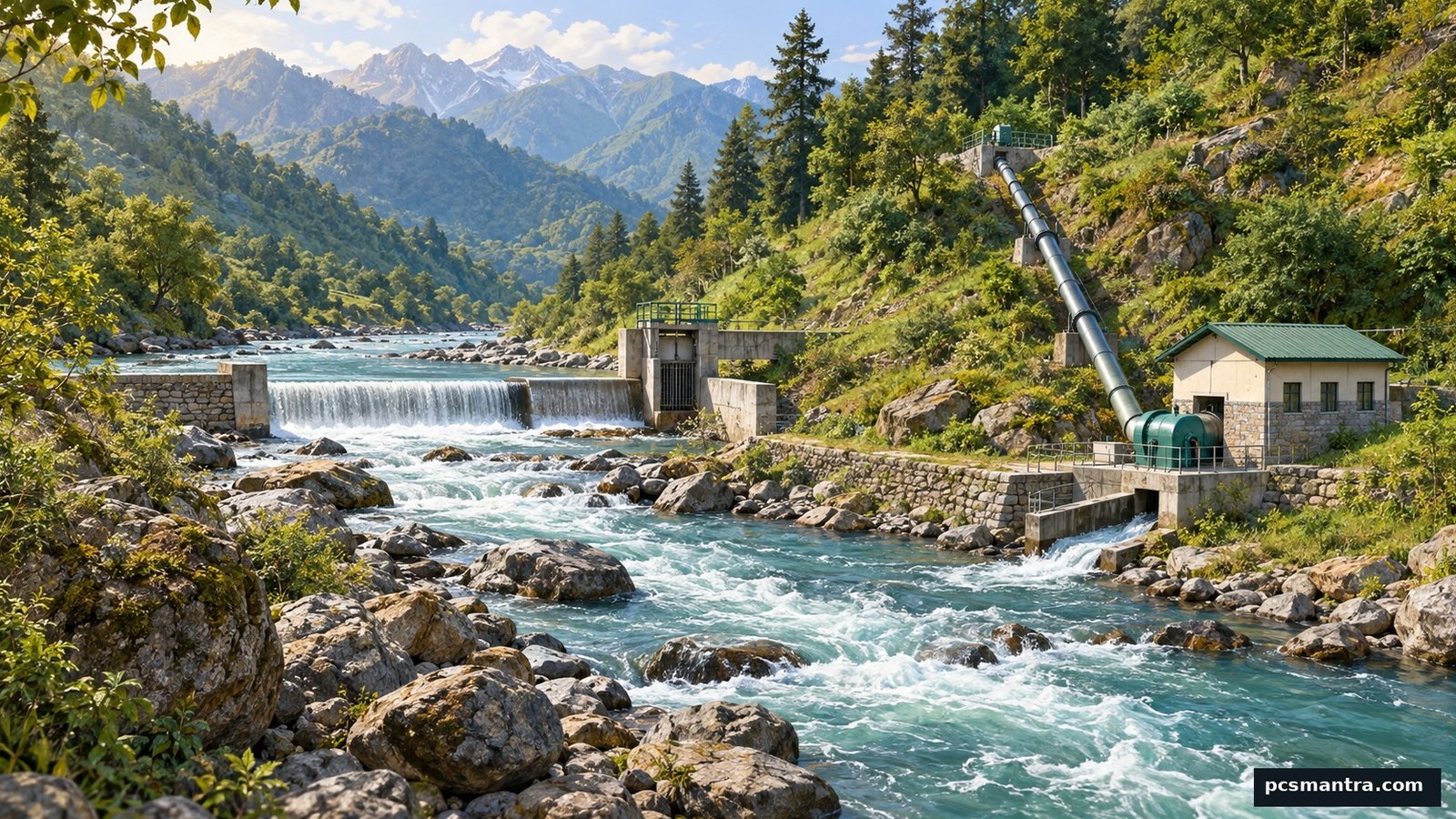
In India, hydropower projects with installed capacity up to 25 MW fall in the small-hydro category, administered by the Ministry of New and Renewable Energy (MNRE). Flowing water and a difference in elevation drive a turbine connected to a generator. The category ceiling is not the same as scheme eligibility: this scheme supports projects from 1 MW to 25 MW.
Scale of the scheme
The scheme has an outlay of Rs 2,584.60 crore and targets about 1,500 MW of new capacity. Solar Energy Corporation of India Limited (SECI) is the National Programme Implementing Agency. MNRE guidelines also provide Rs 30 crore to support detailed project reports (DPRs) for at least 200 projects. A target is not capacity already installed.
Reading financial support
Central Financial Assistance (CFA) supports eligible project costs; it does not pay the entire project cost. For North-Eastern States and districts with international borders, the guidelines provide up to 30% of the applicable normative capital cost or actual cost, whichever is lower, capped at Rs 30 crore per project. For other locations, the corresponding limit is 20%, capped at Rs 20 crore per project. Effective assistance per MW varies with location and project size. A single rupee-per-MW rate should therefore not be applied across India.
Capacity is not generation
The PIB account of 22 November gives an identified potential of 21,134 MW and about 5,182 MW harnessed as of 30 September 2026. Potential estimates a resource; installed capacity is the rating of equipment; generation measures energy produced over time. MW measures capacity, whereas MWh measures energy. Seasonal water availability means that equal installed capacity does not guarantee equal monthly generation.
Opportunities and safeguards
Generation near local demand can reduce the need for long transmission lines in remote and hilly areas. Small does not mean environmentally impact-free. Environmental flows, fish movement, sediment, construction debris, disaster risks and community needs require project-specific assessment. Several small projects on one river also require attention to cumulative impacts. These are analytical checks, not a claim that every project causes harm.
Way forward
Financial support should be combined with reliable hydrological data, clear approvals, local participation and maintenance capacity. Success should be measured through electricity delivered, environmental compliance, cost and reliable local service, rather than sanctioned MW alone.
Prelims practice
Question 1. Consider the following statements about small hydropower:
Statement 1: In India, hydropower projects with installed capacity up to 25 MW fall in this category.
Statement 2: Megawatt-hour is a unit of installed capacity.
Which of the statements given above is/are correct?
Answer and explanation
Answer: (a).
Statement 1 is correct. Statement 2 is incorrect: MW measures capacity and MWh measures energy. The category ceiling and eligibility under a particular scheme must be read separately.
Frequently asked questions
Was the scheme first approved in November?
No. Cabinet approval was on 18 March 2026; the 22 November account provides a fresh context.
Is every small-hydro project eligible?
No. The scheme covers 1-25 MW and imposes other eligibility conditions.
Does assistance pay the full cost?
No. Assistance covers a limited share of costs and is subject to a project cap.
Sources
- https://www.pib.gov.in/PressReleasePage.aspx?PRID=2339965&lang=2®=48
- https://www.pib.gov.in/PressReleasePage.aspx?PRID=2241812&lang=1®=1
- https://nrep.mnre.gov.in/guidelines-shp
Download this article: PDF