
Published: 26 November 2026
In this article
Why in news
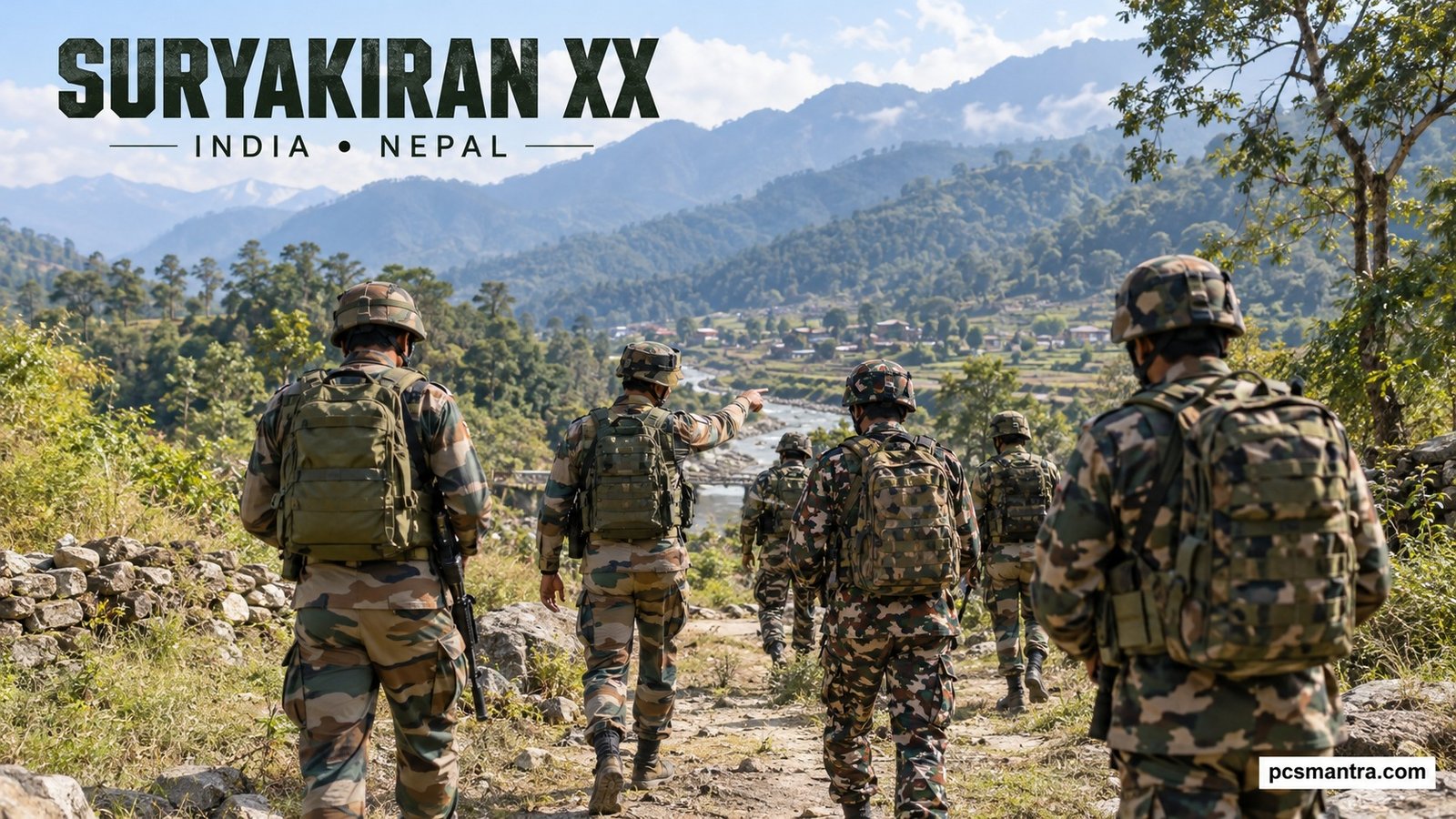
The 20th edition of SURYAKIRAN, the India-Nepal joint military exercise, began on 25 November 2026 at the Nepal Army Battle School, Saljhandi, in Nepal. It runs from 25 November to 8 December 2026. [1]
Key facts of the exercise
Who is taking part: the Indian contingent has 334 personnel, represented by troops of the Kumaon Regiment. The Nepal Army contingent is of equal strength, represented by the Shri Jawla Dal Battalion.
Opening: the opening ceremony was graced by Major General Purna Bahadur Khatri, General Officer Commanding, Mid Western Division, Nepal Army.
Aim: to enhance interoperability, operational coordination and mutual understanding between the two armies through joint training in counter-insurgency and counter-terrorism operations in challenging terrain.
Scope: joint tactical operations, heliborne operations, disaster response and medical training. The two armies will exchange operational experiences and best practices and refine tactics, techniques and procedures.
The SURYAKIRAN series
This annual bilateral exercise is held alternately in India and Nepal. The 16th edition ran from 16 to 29 December 2022 at the Nepal Army Battle School, Saljhandi. The 18th edition ran from 31 December 2024 to 13 January 2025 at Saljhandi, Nepal. [1][2][3]
For the exam, note that the edition number and venue are often asked. The 20th edition is being held in Nepal, at Saljhandi.
Related concepts
Bilateral exercise: a military exercise between two countries, as against a multilateral exercise with more than two participants.
Counter-insurgency and counter-terrorism operations: the first covers strategies against armed insurgent groups, the second the prevention of and response to terrorist attacks. Both need specialised training in difficult hill and forest terrain.
HADR (humanitarian assistance and disaster relief): relief and rescue work carried out by armed forces during natural disasters. Disaster response is part of this exercise's scope.
Analysis for the exam
Neighbourhood first: India and Nepal share an open border, contiguous terrain and disaster risks. Regular contact between the armies builds trust and coordination. The release itself links the exercise to mutual trust and a shared commitment to regional peace, stability and security.
Nature of training: the mix of counter-terrorism with disaster response and medical training keeps the exercise from being purely combat-oriented.
Limits: the release gives no outcomes or evaluation criteria, so the real effect of the exercise can be judged only from later reports. The release does not link the exercise to any other event or international framework, so claims of such links should not be written as fact.
Way forward
Bilateral defence cooperation can be tied to training exchanges, joint work on disaster preparedness and information sharing, beyond the exercises themselves. In India-Nepal relations more broadly, balance across defence, trade, energy and people-to-people ties matters for long-term trust.
Prelims practice question
Question 1. Consider the following statements regarding SURYAKIRAN, the India-Nepal joint military exercise:
Statement 1: It is an annual bilateral exercise held alternately in India and Nepal.
Statement 2: Its 20th edition is being held from 25 November to 8 December 2026 at the Nepal Army Battle School, Saljhandi.
Statement 3: The Indian contingent is represented by a detachment of the Gorkha Rifles.
Which of the statements given above are correct?
Answer and explanation
Answer: (c).
Statement 1 is correct: SURYAKIRAN is an annual bilateral exercise held alternately in the two countries. Statement 2 is correct: the 20th edition is at Saljhandi from 25 November to 8 December 2026. Statement 3 is incorrect: the Indian contingent is represented by troops of the Kumaon Regiment.
Question 2. What is the stated aim of the SURYAKIRAN exercise?
Answer and explanation
Answer: (b).
Per the official release, the aim is to enhance interoperability, operational coordination and mutual understanding through joint training in counter-insurgency and counter-terrorism operations in challenging terrain. The other options are not in the release.
Mains practice question
Question 1. "The role of bilateral military exercises like SURYAKIRAN in India's Neighbourhood First policy is not limited to training." Analyse in the context of India-Nepal relations. (250 words, 15 marks)
Answer outline
Introduction: A brief introduction to SURYAKIRAN: the 20th edition, participating armies, dates and venue.
Body: The stated aim and scope (counter-terrorism, counter-insurgency, heliborne operations, disaster response, medical training); the context of the open border and shared terrain; trust building; limits, such as the lack of outcome evaluation, and the need to balance defence with other areas of the relationship.
Conclusion: A balanced conclusion: military cooperation underpins trust, but long-term ties also need economic, energy and people-to-people dimensions.
Sources
- https://www.pib.gov.in/PressReleseDetailm.aspx?PRID=2341241&lang=1®=3 (PIB, India-Nepal Joint Military Exercise SURYAKIRAN XX commences in Nepal, 25 November 2026)
- https://www.pib.gov.in/PressReleasePage.aspx?PRID=2088538 (PIB, earlier edition, Indian contingent departs for SURYAKIRAN (18th edition), December 2024)
- https://www.pib.gov.in/PressReleasePage.aspx?PRID=1883751&lang=2®=3 (PIB, SURYAKIRAN XVI, December 2022)
Frequently asked questions
What is the SURYAKIRAN exercise?
It is an annual bilateral military exercise between the Indian and Nepal armies, held alternately in the two countries.
When and where is the 20th edition being held?
From 25 November to 8 December 2026, at the Nepal Army Battle School, Saljhandi, Nepal.
Which units are taking part?
A Kumaon Regiment detachment of 334 personnel from India, and an equal number of personnel from the Shri Jawla Dal Battalion of the Nepal Army.
What will the exercise cover?
Joint tactical operations, heliborne operations, disaster response and medical training, centred on counter-insurgency and counter-terrorism operations.
Download this article: PDF