
Why in the News?
Questions have been raised about a substantial revision of the declared cost of the 1,500 MW Tarali pumped-storage project in Maharashtra's Satara district and its effect on a conservation deposit. The available news report describes a central direction to investigate on priority. An inquiry direction is not a final finding of wrongdoing or a conviction. The exam focus is the value of energy storage and independent scrutiny of environmental conditions.
What Does the Official Document Establish?
The environmental-clearance letter dated 11 February 2025 identifies the project as the Tarali Open Loop Pumped Storage Project. It is a Ministry of Environment, Forest and Climate Change letter available on the project company's website.
| Fact | Position in the clearance letter |
|---|---|
| Capacity | 1,500 MW |
| Location | Patan sub-district, Satara district, Maharashtra |
| Villages | Nivade, Tondoshi, Kalambe and Jalu |
| Project area | 150.74 hectares |
| Estimated cost at that time | ₹5,675 crore |
| Nearby protected areas | Sahyadri Tiger Reserve and Koyna Wildlife Sanctuary |
The letter says no project component falls inside a notified protected area. It also records the need for wildlife clearance from the National Board for Wildlife because the eco-sensitive zones had not been notified at that time. Being outside a protected area's notified boundary therefore does not mean exemption from wildlife-related conditions.
The Conservation-Deposit Dispute
The 13 November report says a later company affidavit stated a cost of ₹56.75 crore, compared with ₹5,675 crore in the earlier clearance letter. It describes the implications for a cost-linked conservation deposit and a ministry direction dated 6 November to investigate.
Evidence limit: The original clearance letter verifies the earlier ₹5,675 crore figure. Original copies of the later affidavit and inquiry direction were not available for this article. Subsequent developments are therefore presented as matters reported to be under scrutiny, not independently established final findings. The inquiry should clarify the cost assessment and application of the relevant condition.
Do not generalise the rate: A cost-linked conservation condition imposed in a particular case should not be treated as a uniform national rate applicable to every Indian energy project.
How Does Pumped Storage Work?
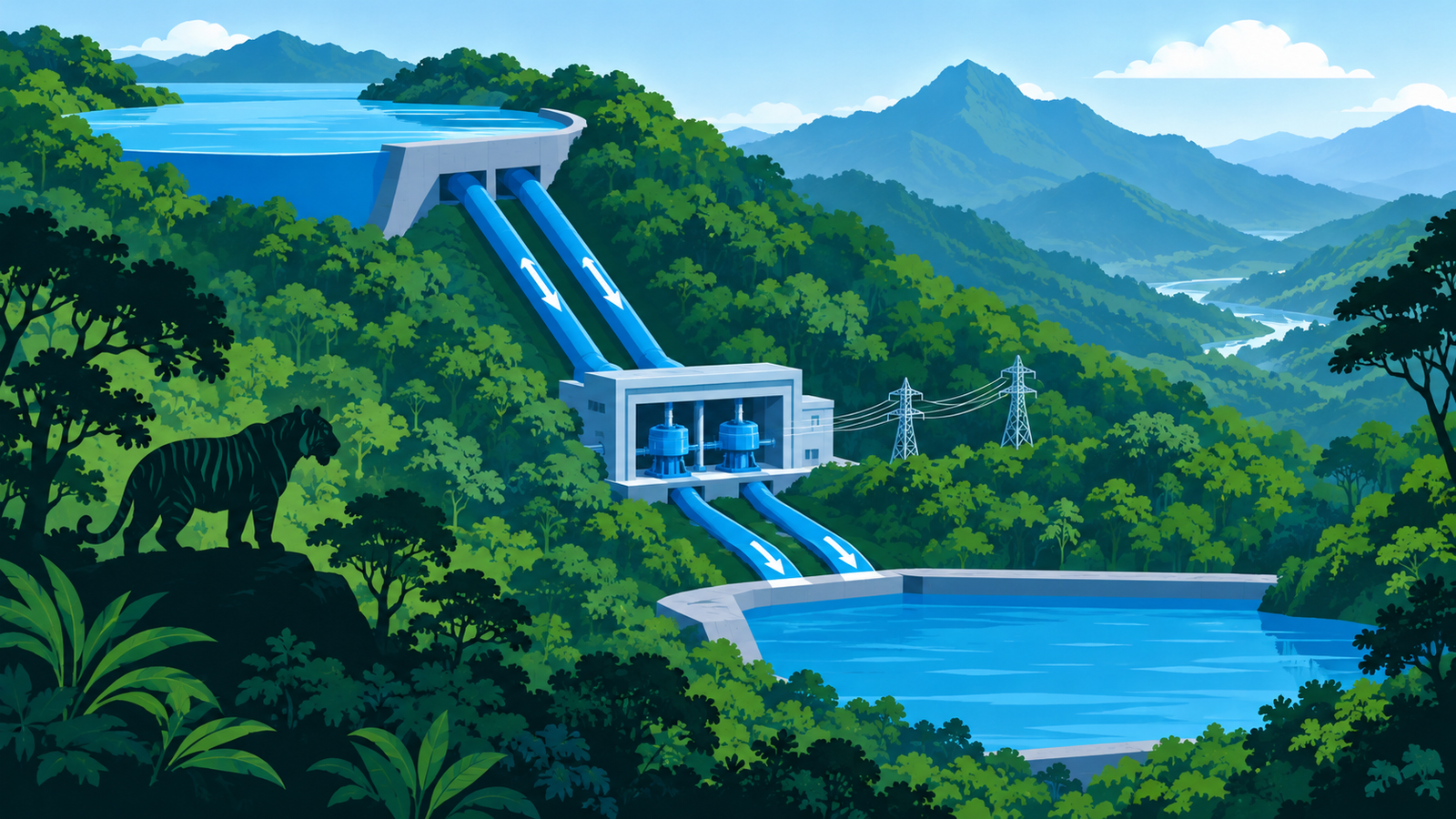
Storage: When electricity is available, water is pumped from a lower to an upper reservoir. It is released downhill through turbines when electricity is needed. Electrical energy is thus stored as gravitational potential energy.
Not a primary energy source: Energy is lost during pumping and generation. The system stores energy and shifts supply across time; it does not continuously create net electricity without external energy input.
Open loop: An open-loop pumped-storage system is connected to a natural water system. Tarali's official designation is open loop; it should not be called closed loop without verification.
Different Approvals Address Different Questions
- Environmental clearance: Evaluates environmental effects and management conditions.
- Forest-related approval: Becomes relevant where forest land is diverted for non-forest use under applicable law and procedure.
- Wildlife clearance: Can involve a separate assessment of effects and conditions concerning protected areas and wildlife.
The original clearance letter explicitly states that environmental clearance does not replace permissions required under other laws. A claim that work is on private or non-forest land does not, by itself, remove every environmental obligation.
The Way Forward
Energy-storage expansion may be important, but its environmental costs must remain transparent and verifiable. Cost-based conditions need an auditable valuation method, reasons for revisions and a clear deposit calculation. This supports conservation and public confidence in clean-energy projects.
Prelims practice questions
Question 1. The Tarali pumped-storage project is situated in Satara district of which state?
(a) Maharashtra
(b) Karnataka
(c) Telangana
(d) Madhya Pradesh
Answer and explanation
Answer: (a)
Tarali is in Patan sub-district of Satara, Maharashtra. The other states are not the location of this project.
Question 2. Consider the following statements:
1. Pumped storage can store energy by moving water to a higher elevation.
2. Environmental clearance automatically grants every permission required under other applicable laws.
3. Energy losses can occur over a complete pumped-storage cycle.
Which of the statements given above are correct?
(a) 1 and 2 only
(b) 2 and 3 only
(c) 1 and 3 only
(d) 1, 2 and 3
Answer and explanation
Answer: (c)
Statement 1 is correct: Water in the upper reservoir stores gravitational potential energy. Statement 2 is incorrect: Other legally required permissions must be obtained separately. Statement 3 is correct: Pumping and generation involve losses. The system stores energy rather than creating it without an input.
Mains practice question
How can energy-storage needs be balanced with environmental accountability? Discuss with reference to pumped-storage projects. (150 words, 10 marks)
Answer outline:
In the introduction: Explain pumped storage's role in storing energy and shifting supply across time.
In the body: Discuss location, water systems and wildlife effects; separate approvals; transparent cost-based conditions; independent verification and compliance monitoring. Do not equate an inquiry with a final finding of guilt.
In the conclusion: Storage benefits and conservation conditions are joint foundations of responsible project development, not alternatives.
Frequently Asked Questions (FAQ)
Summary answer: Questions have been raised about a substantial revision of the declared cost of the 1,500 MW Tarali pumped-storage project in Maharashtra's Satara district and its effect on a conservation deposit.
Question: Where is Tarali and what is its capacity?
The project is in Patan sub-district of Satara, Maharashtra. The environmental-clearance letter lists a capacity of 1,500 MW.
Question: How does pumped storage store electricity?
Electricity is used to pump water uphill. Water is later released through turbines to generate electricity when needed. Energy is lost over the complete cycle.
Question: Does environmental clearance replace other permissions?
No. The clearance letter states that permissions required under other applicable laws must be obtained separately.
Question: Does an inquiry direction establish wrongdoing?
No. An inquiry direction is not a final finding of wrongdoing. Developments concerning the later affidavit and inquiry direction are presented here through news reporting with an explicit evidence limit.
Sources
- [Press] [Tarali project environmental clearance, File J-12011/52/2023-IA.I (R)](https://www.adanigreenenergy.com/-/media/project/greenenergy/corporate-announcement/others/environment-clearance---tarali.pdf)
- [Press] [Explained: Adani Green Satara project cost revision](https://indianexpress.com/article/express-exclusive/explained-adani-green-satara-project-cost-cut-rs-227-crore-10961357/)
Download This Article: PDF