
News reference: 27 November 2026
Published: 28 November 2026
Mains: GS-II, e-governance; GS-III, land reforms
In this article
Why in the news
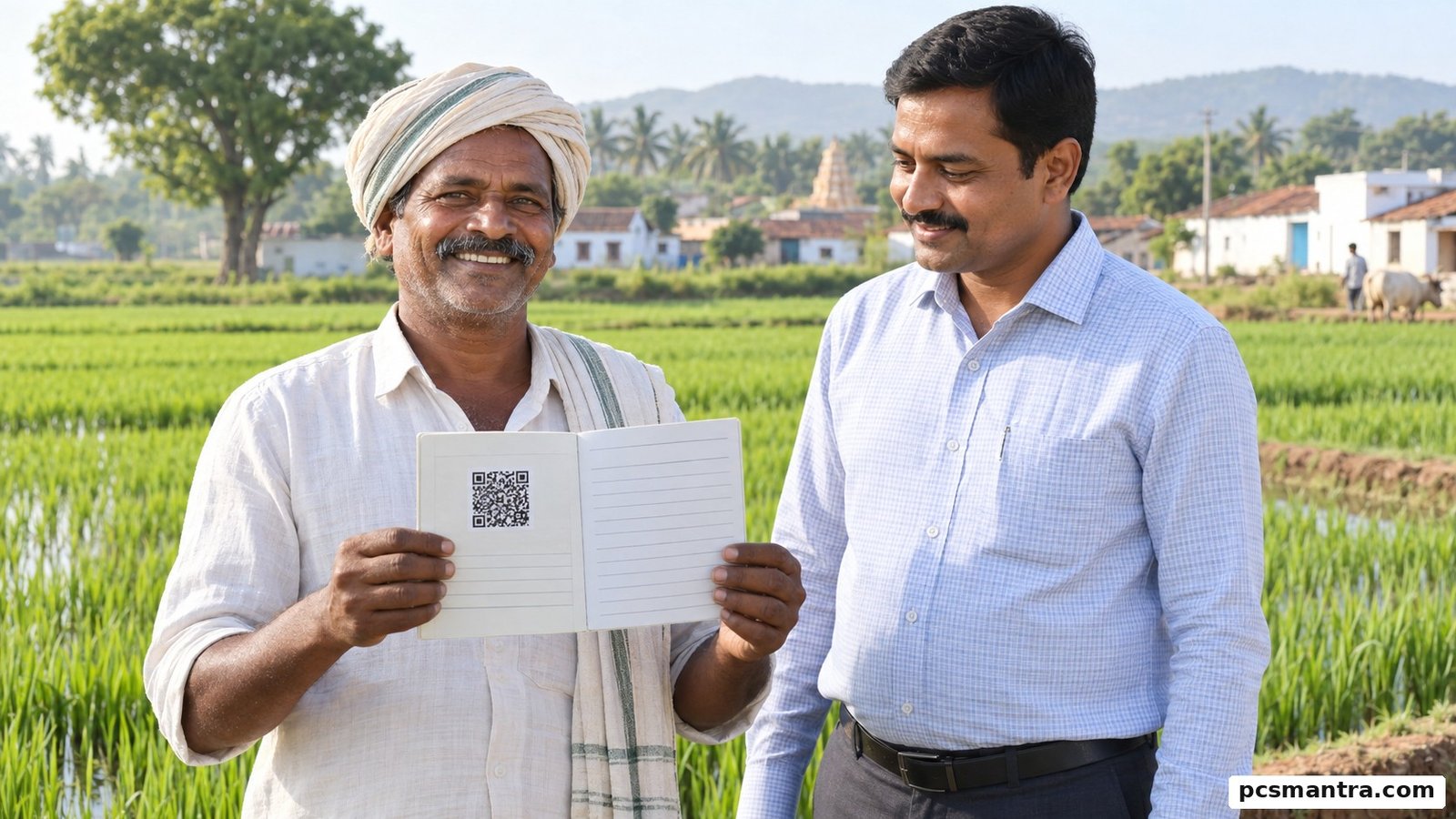
Revenue Minister Ponguleti Srinivas Reddy said on 27 November 2026 that the state aims to complete a comprehensive land resurvey within 18 months; its first phase is under way in 373 villages that do not have proper maps, with a target of completing it by the end of December. After the resurvey, farmers will get free, waterproof, QR-coded pattadar passbooks; scanning the QR code will show the survey number, the extent of the land and the land parcel map, and several survey numbers will be linked in a single passbook. Separate-colour passbooks are also planned for agricultural land and abadi/residential property.
A report dated 27 November cites a senior Revenue department official as saying that the passbook design is in its final stages. According to the official, issuance could begin soon in over 530 villages where surveys are complete and time for claims and objections has been given.
Basics: Pattadar passbook: the ownership document issued by the Revenue department to a landholder (pattadar), carrying the account, survey number and details of the land. Coordinates: a place's precise geographic position (latitude-longitude based). Land resurvey: re-measuring old survey records with modern technology so that boundary disputes and record mismatches come down. Bhudhaar: the unique identification number given to every survey number in Telangana. DILRMP: the Digital India Land Records Modernisation Programme , the Central scheme under which computerisation of land records, digitisation of maps and survey/resurvey are taken up.
Key facts of the scheme
The main facts, as per the minister's statements and the reports.
| Point | Detail |
|---|---|
| What is special | Free, waterproof, QR-coded; scanning the QR code shows the survey number, extent and land parcel map; several survey numbers linked in one passbook (Minister, 27 November 2026) |
| Colour coding | Separate-colour passbooks planned for agricultural land and abadi/residential property |
| Status | To be issued after the resurvey, as per the minister; design in final stages, as per a senior Revenue official |
| Resurvey | Comprehensive resurvey of the whole state in 18 months; first phase under way in 373 villages (those without proper maps), targeted for completion by end-December (27 November statement) |
| State coverage | 10,954 revenue villages in the state; resurvey in three phases (minister's 17 October 2026 briefing) |
| Digital identity | A unique 'Bhudhaar' number for every survey number; the Bhu Bharati portal; survey numbers in the state have risen from about 40 lakh in 1948 to 2.29 crore (17 October briefing) |
| Link with the Centre | Described as complementary to the DILRMP |
| Use | Departments such as Agriculture will use the land data and coordinates; delivery and monitoring of farmer-welfare schemes |
The larger goal: a digital registry
The passbook is part of a wider land-records system. As per the report, the survey data will feed a comprehensive digital registry, which may be entrusted to a nodal agency so that survey outcomes are used in the delivery of schemes. Its potential benefits.
- Targeted delivery: with the nature and use of land recorded, help such as fertiliser, urea and seed can reach the right beneficiary.
- Scheme monitoring: payments and reach of farmer-welfare schemes can be reviewed against real land data.
- Fewer disputes: clear maps and survey details weaken the basis of boundary disputes.
- Inter-departmental use: the Agriculture department can link crop planning, irrigation and insurance to the land data.
Resurvey: the foundation of the plan
The reliability of the new passbook rests on the accuracy of the survey. As per the minister's 27 November statement, the state aims to complete a comprehensive resurvey in 18 months; the first phase is under way in 373 villages , those without proper maps , and is to be completed by end-December. As per the minister's 17 October briefing, the state has 10,954 revenue villages, the resurvey will run in three phases, every survey number will get a unique 'Bhudhaar' number, and the work is tied to the Bhu Bharati portal; the number of survey numbers in the state has risen from about 40 lakh in 1948 to 2.29 crore.
After the survey, landholders receive time to file claims and objections. A senior Revenue department official is reported to have said that surveys are complete in over 530 villages and time for claims and objections has been given; issuance could begin there soon. The minister's 17 October briefing put completed surveys at 285 villages. The newer figure of over 530 comes from the report citing the official; no supporting official document was found.
Link with the Central programme
The step has been described as complementary to the Centre's Digital India Land Records Modernisation Programme (DILRMP). Under the DILRMP, computerisation of land records, digitisation of record maps, surveys and real-time updating of records are under way. The SVAMITVA scheme uses drone-based surveys for property cards in rural inhabited areas. It is a separate example of technology supporting property records. The speciality of Telangana's passbook is that, through the QR code, it ties the map and land details directly into the ownership document.
Exam relevance
Prelims facts: the state (Telangana), the passbook's features (free, waterproof, QR code; several survey numbers in one passbook; separate colours for agriculture and abadi), the resurvey numbers (18-month target; 373 villages in the first phase; 10,954 revenue villages; three phases), Bhudhaar and the Bhu Bharati portal, the DILRMP link , all directly askable.
Mains angle: improving service delivery through e-governance; the challenges of land-records modernisation (state-level law, survey capacity, grievance settlement); data-driven agricultural policy. (GS-2: e-governance and service delivery; GS-3: land reforms, agricultural infrastructure.)
Way forward
Worth tracking: completion of the first phase (373 villages) by end-December, the formal launch of passbook distribution and the final design announcement; the name of the nodal agency and the shape of the digital registry.
Challenges: settlement of objections, survey quality, and privacy , security standards linked to public scanning of land data.
Replication: whether other states adopt this model , inter-state comparison will be possible under the DILRMP.
Conclusion
Telangana's new pattadar passbook is an attempt to take land records 'from paper to map'. For the exam, three things: what it is (a free, waterproof, QR-coded passbook), how it will be built (resurvey, claims-objections, digital registry), and which larger direction it belongs to (the DILRMP and e-governance).
Mains practice question
Question 1. "Digital land records are not merely record correction; they are the foundation of service delivery." Comment in the light of Telangana's pattadar passbook initiative. (250 words, 15 marks)
Answer outline
Introduction: a brief introduction to Telangana's QR-coded passbook and comprehensive resurvey initiative (Revenue Minister's statement of 27 November 2026); the DILRMP link.
Body: Supporting the statement: targeted delivery (fertiliser, seed, insurance) from accurate land data, scheme monitoring, fewer disputes, inter-departmental use; the prospect of a digital registry and a nodal agency; the role of a unique identity such as Bhudhaar. Balance/challenges: survey quality and objection settlement, privacy and data security, legal recognition (the record-versus-title distinction), capacity building. Lessons for other states.
Conclusion: end by calling the 'record-to-service' chain the true test of reform.
Frequently asked questions (FAQ)
Short answer: The Telangana government is preparing to give farmers free, waterproof, QR-coded pattadar passbooks after a resurvey; the first phase of the resurvey is under way in 373 villages, with a target of resurveying the whole state in 18 months. The initiative has been described as complementary to the DILRMP.
Q1. What will be special about the new passbook?
It will be free, waterproof and QR-coded; scanning the QR code will show the survey number, the extent of the land and the land parcel map, and several survey numbers will be linked in a single passbook. Separate-colour passbooks are planned for agricultural and abadi/residential property.
Q2. When and where will the passbooks be issued?
As per the minister's statement of 27 November 2026, the passbooks will be issued after the resurvey; the first phase is under way in 373 villages and is targeted for completion by end-December. As per a senior Revenue official, the design is in its final stages and issuance could begin soon in over 530 villages where surveys are complete and time for claims and objections has been given.
Q3. What is the benefit to the farmer?
Precise identification in the ownership document, fewer disputes, and targeted delivery of schemes (fertiliser, seed, payments) , because departments will be able to use data on the land's map, extent and nature.
Sources
- Free, waterproof QR-coded passbooks; resurvey in 18 months; first phase of 373 villages (Minister Ponguleti Srinivas Reddy, 27 November 2026) , Times of India: https://timesofindia.indiatimes.com/city/hyderabad/telangana-govt-to-issue-waterproof-pattadar-passbooks-with-qr-codes-after-land-resurvey-says-minister-ponguleti/articleshow/136226025.cms
- Comprehensive land resurvey in 18 months (Minister, 27 November 2026) , Deccan Chronicle: https://www.deccanchronicle.com/southern-states/telangana/telangana-to-complete-comprehensive-land-resurvey-in-18-months-ponguleti-2008646
- 10,954 revenue villages; three phases; Bhudhaar; Bhu Bharati; survey numbers from ~40 lakh (1948) to 2.29 crore (minister's 17 October 2026 briefing) , The Hindu: https://www.thehindu.com/news/national/telangana/comprehensive-telangana-land-resurvey-to-be-completed-in-three-phases-for-clear-ownership-rights-ponguleti/article71596164.ece
- Passbook design in final stages; issuance process in 530+ villages (citing a senior Revenue official, 27 November 2026) , The Hindu: https://www.thehindu.com/news/national/telangana/telanganas-new-pattadar-passbooks-to-have-unique-code-land-maps/article71750274.ece
- DILRMP , land records modernisation programme (background): https://dilrmp.gov.in/
Download this article: PDF