
Published: 26 November 2026
In this article
Why in news
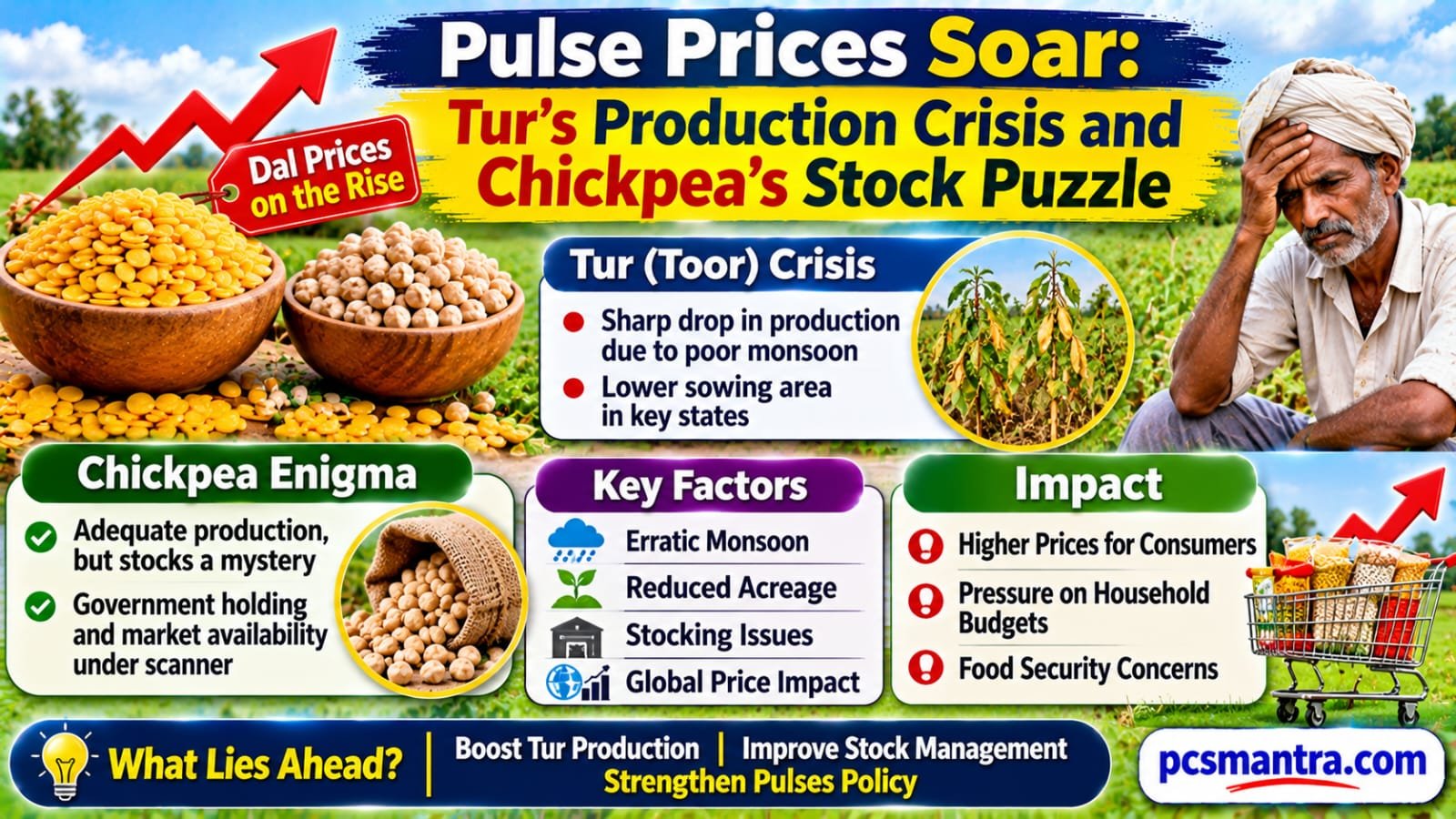
Pulse prices in India are rising fast. According to an expert analysis (25 November), after 15 consecutive months of deflation, wholesale pulses inflation turned positive in May 2026 and reached 12.7 per cent by October. Mandi prices (Agmarknet) are under greater pressure: by 17 November, gram was at about Rs 73 per kg (nearly 32 per cent above last year) and tur (arhar) at about Rs 97 per kg (up nearly 51 per cent). Per Department of Consumer Affairs data, retail prices are about Rs 96 per kg for gram dal and Rs 137 per kg for tur dal.
The low-base effect: the column notes that part of the jump reflects a low base, since both pulses sold below the minimum support price (MSP) last year. Percentage increases should therefore be read together with price levels.
Tur: the production worry
Acreage up, crop in trouble: tur acreage rose 3.2 per cent this kharif to 47.93 lakh hectares, but drought has hit Maharashtra and Karnataka, which together produce nearly 54 per cent of the country's tur. In Karnataka, drought affected about 10.14 lakh hectares, roughly two-thirds of its tur area (citing the Crop Weather Watch Group).
Production estimates: according to the column, early market assessments put 2026-27 tur production at 25 to 28 lakh tonnes. For comparison, the Third Advance Estimates (PIB, 27 May 2026) put 2025-26 tur production at 35.92 lakh tonnes. The assessments therefore imply a sharp fall, but they are not final official estimates.
The import cushion: the column says imports last year equalled about 40 per cent of domestic production. This time some exporters in Myanmar and Africa are delaying shipments in anticipation of higher Indian demand.
Gram: the inventory mystery
The paradox: the Third Advance Estimates (PIB, 27 May 2026) put 2025-26 gram production at 125.14 lakh tonnes, while the column puts estimated annual consumption at 95 lakh tonnes to 1 crore tonnes. Government agencies also hold sizeable inventories. Yet prices are rising.
Three possibilities: either the crop was smaller than estimated, or stocks are being held back, or demand is shifting from costlier tur to gram. According to the column, the government does not yet know which.
The worry ahead: by 13 November, gram sowing had reached only 31.1 lakh hectares, nearly 22 per cent below last year. Delayed sowing, uneven soil moisture and the risk of above-normal temperatures later in the rabi season add uncertainty. Australia's chickpea crop is expected to halve, which weakens the import option.
Why the two need different responses
For tur: the authors argue that the priority is securing supplies. Government stocks should be verified and released judiciously, the duty-free import window should extend beyond March 2027, and district-level crop assessments in Maharashtra and Karnataka should establish losses.
Tur stocks: the column puts government stocks at about 7 lakh tonnes, provisionally; press reports differ (about 9.7 lakh tonnes, per a 20 November news report). A verified figure is needed first.
For gram: the authors argue that the first task is to establish how much is actually available. Verified NAFED and NCCF inventories, disclosure of private stocks and a predictable release plan could calm expectations. They suggest the 30 per cent duty on yellow peas should stay for now, because cheaper imports could undermine sowing.
On stock limits: the authors argue that tur's new crop arrives within weeks, so stock limits now would cap how much traders can buy at harvest. Gram's harvest is four months away, so the policy design there must differ.
A government step: according to press reports, the Department of Consumer Affairs made weekly declaration of pulses stocks mandatory on 13 November, to be filed every Friday. The reports put the government buffer at about 38 lakh tonnes, including about 16.1 lakh tonnes of gram and about 9.7 lakh tonnes of tur.
Mission for Aatmanirbharta in Pulses
The Union Cabinet approved the Mission for Aatmanirbharta in Pulses on 1 October 2025 and it was launched on 11 October 2025, with an outlay of Rs 11,440 crore. It targets pulses production of 350 lakh tonnes and area of 310 lakh hectares by 2030-31. The baseline in 2023-24 was 242 lakh tonnes of production from 275 lakh hectares. The Third Advance Estimates put total pulses production in 2025-26 at 274.09 lakh tonnes (PIB, 7 August 2026).
The column notes that pulses area has been falling since 2021-22, which makes the target ambitious. The current price rise is being seen as an early test for the Mission.
Analysis for the exam
Reading the signals: two pulses facing different problems at once, a possible production shortfall in one and inventory uncertainty in the other, shows that price policy must rest on accurate data.
Crop economics: the authors note that tur occupies land for eight to nine months, in which a farmer could grow two shorter crops. Without shorter-duration, climate-resilient varieties, bringing farmers back to tur is difficult. Assured MSP procurement gives farmers a floor, but with prices well above MSP, government stock-building is unlikely this year.
The data gap: data on acreage, weather, stocks, prices and trade exist but rarely come together in time. The authors suggest a pulses monitoring cell pooling these data every fortnight so that decisions are made before prices force them.
Way forward
Supply security for tur, inventory transparency for gram and a long-term fix to crop economics should move together. Steps such as the weekly stock declaration can help close the data gap. The real test of the Mission will be whether, while moving toward its production and area targets, it also gives the market timely and credible information.
Prelims practice question
Question 1. Consider the following statements regarding official estimates of pulses production:
Statement 1: According to the Third Advance Estimates (27 May 2026), gram production in 2025-26 is estimated at 125.14 lakh tonnes.
Statement 2: According to the same estimates, tur production in 2025-26 exceeds 45 lakh tonnes.
Statement 3: Total pulses production in 2025-26 is estimated at 274.09 lakh tonnes.
Which of the statements given above are correct?
Answer and explanation
Answer: (c)
Statement 1 is correct: the Third Advance Estimates put gram at 125.14 lakh tonnes. Statement 2 is incorrect: tur is estimated at 35.92 lakh tonnes. Statement 3 is correct: total pulses production is 274.09 lakh tonnes (PIB).
Question 2. What production target does the Mission for Aatmanirbharta in Pulses set for 2030-31?
Answer and explanation
Answer: (a)
The Mission targets pulses production of 350 lakh tonnes (and area of 310 lakh hectares) by 2030-31. The figure near 274 lakh tonnes is the 2025-26 production estimate, not the target (PIB).
Mains practice question
Question 1. "Rising tur and gram prices have different underlying causes, so the policy response must also differ." Examine this statement and suggest an institutional arrangement for price stability in the pulses sector. (250 words, 15 marks)
Answer outline
Introduction: wholesale pulses inflation turning positive and the current mandi price situation in brief, with a note on the low base.
Body: drought-linked production risk in tur; the production estimate and inventory paradox in gram; supply security versus inventory transparency; timing of stock limits; import policy; the Mission and crop economics; the weekly stock declaration; the proposed pulses monitoring cell.
Conclusion: a balanced conclusion: only data-driven, crop-specific policy can deliver durable price stability.
Sources
- https://indianexpress.com/article/opinion/columns/behind-rising-tur-and-gram-prices-a-supply-problem-and-an-inventory-mystery-10978276/
- https://www.pib.gov.in/PressReleasePage.aspx?PRID=2265965
- https://www.pib.gov.in/PressReleasePage.aspx?PRID=2173650
- https://www.pib.gov.in/PressReleasePage.aspx?PRID=2177847
- https://www.pib.gov.in/PressReleasePage.aspx?PRID=2180212
- https://www.pib.gov.in/PressReleasePage.aspx?PRID=2296205
- https://timesofindia.indiatimes.com/india/as-dal-prices-rise-despite-robust-availability-govt-makes-weekly-disclosure-mandatory/articleshow/135813041.cms
- https://www.financialexpress.com/policy/economy-rising-prices-of-pulses-govt-make-stock-declaration-mandatory-4383888/
- https://agriculture.economictimes.indiatimes.com/news/markets-and-trade/tur-prices-stay-hot-despite-ample-buffer-stock-as-crop-worries-deepen/135990107
Source [1] is an expert column. Production estimates and Mission facts are from PIB (sources 2 to 6). The stock declaration and buffer figures are from press reports (sources 7 to 9).
Frequently asked questions
What is the essence of the current pulse price rise?
According to an expert analysis, wholesale pulses inflation turned positive in May 2026 and reached 12.7 per cent by October; mandi prices stand near Rs 73 per kg for gram and Rs 97 per kg for tur.
Why are tur prices rising?
Drought in Maharashtra and Karnataka raises fears of a smaller crop, so stocks are being held back and some foreign exporters are delaying shipments.
What is the mystery behind rising gram prices?
Official estimates put production above consumption and inventories exist, yet prices are rising, which raises questions about the production estimate, actual stocks and a demand shift.
What is the target of the Mission for Aatmanirbharta in Pulses?
Launched on 11 October 2025, it targets pulses production of 350 lakh tonnes and area of 310 lakh hectares by 2030-31, with an outlay of Rs 11,440 crore.
Download this article: PDF