
In this article
Why in the news
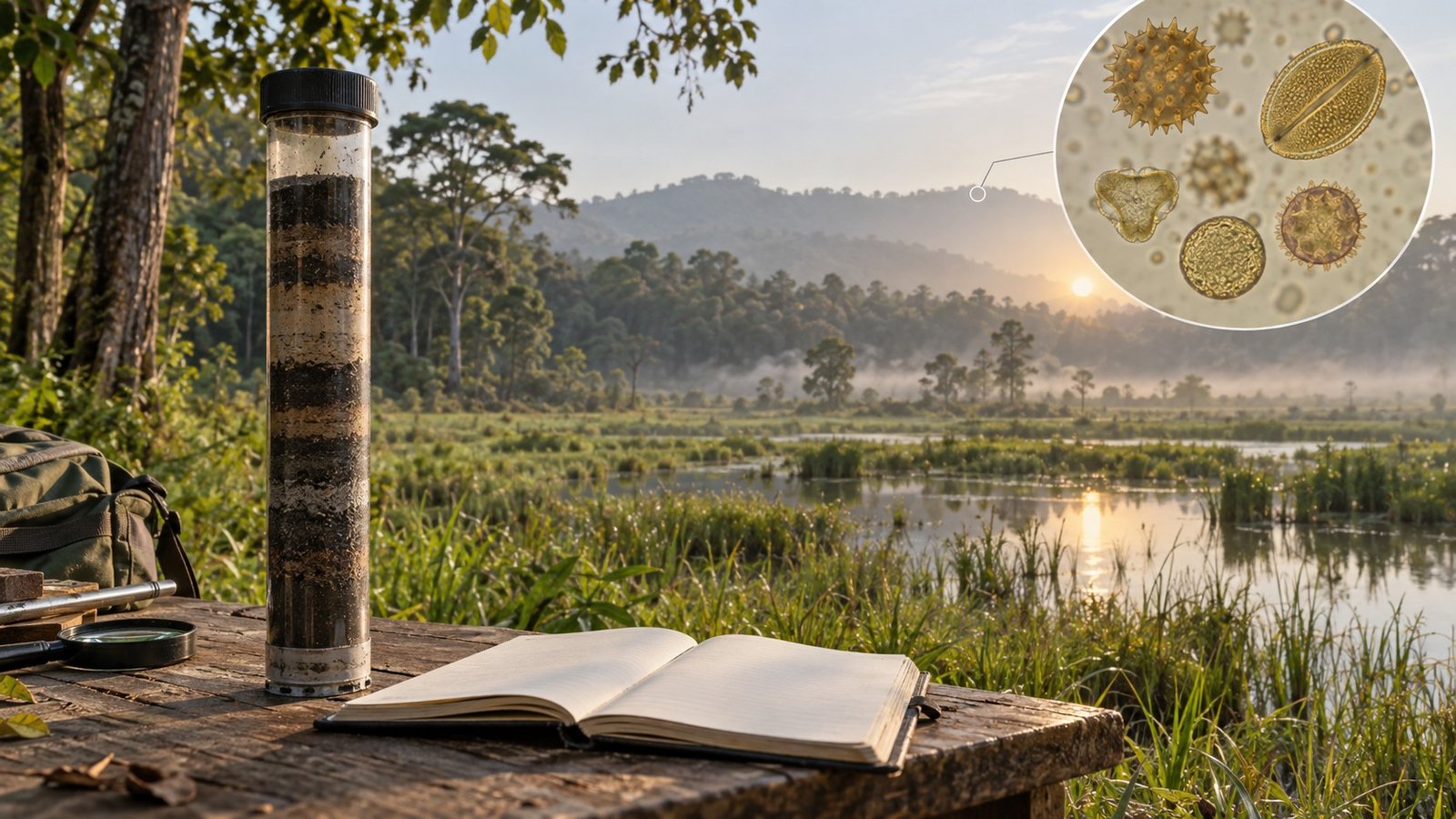
Researchers at the Birbal Sahni Institute of Palaeosciences, an autonomous institute under the Department of Science and Technology, studied sediments from Chakradhara Wetland in Madhya Pradesh's Bandhavgarh Tiger Reserve. They combined pollen records with Earth System Palaeoclimate Simulation (ESPS) to reconstruct roughly 2,700 years of vegetation and Indian Summer Monsoon variability. The findings were published in Quaternary Research.
How pollen helps reconstruct climate
Pollen preserved in sediment provides evidence of past vegetation. Researchers interpret changes between sediment layers alongside a chronology supported by radiocarbon dating. The study compared this record with climate-model results. This is a reconstruction of past environments, not a prediction of rainfall in a particular future year.
Main findings
- A stronger monsoon supported sal-dominated moist deciduous forests around 2,700–2,300 years BP. BP is an age notation; it should not be converted casually into a calendar date without checking the chronology.
- Around 2,300–1,600 years BP, the region experienced phases of humidity, prolonged drought and environmental recovery.
- Relatively stable monsoon conditions occurred around 1,600–820 years BP. Between about 820 and 400 years BP, weaker monsoon conditions accompanied expanding dry deciduous vegetation and more cultivated pollen.
- Stronger monsoon conditions over roughly the last 400 years supported recovery of moist deciduous forests. This helps explain the regenerative capacity of tropical forests under favourable climate conditions.
Bandhavgarh: examination facts
The reserve is in Madhya Pradesh. Umaria district administration records its declaration under Project Tiger in 1993, not 1972. NTCA lists 1993–94 and separately records a 2007 tiger-reserve notification. These administrative stages should not be treated as the same event. NTCA describes moist deciduous forests, sal, mixed forests and grasslands.
Policy relevance and limits
Long records help distinguish the effects of monsoon variability from human land-use change. Conservation should consider climate, water and land use together. However, one wetland record cannot establish identical conditions across India or prove that all degraded forests will recover without intervention.
Mains practice
How can pollen records and climate models improve understanding of monsoon–vegetation relationships? Explain with reference to central India.
Prelims practice
Consider: (1) The recent Bandhavgarh study used pollen records from Chakradhara Wetland. (2) Pollen records can specify the exact date of rainfall in a future year.
Answer and explanation
Answer: (a). Pollen supplies evidence of past environments, not an exact future forecast.
FAQ
What does a pollen record indicate?
Past vegetation and associated environmental change.
Where is Bandhavgarh?
Madhya Pradesh.
When was it included under Project Tiger?
Umaria district administration records 1993; NTCA lists 1993–94 and separately a 2007 notification.
Sources: https://www.dst.gov.in/static/uploads/2026/11/6f8b45c9271cf30cf54ca9e50b82daa7.pdf; https://ntca.gov.in/tiger-reserves/; https://umaria.nic.in/en/places-of-interest/; https://ntca.gov.in/assets/uploads/briefnote/bandhavgarh.pdf; https://doi.org/10.1017/qua.2026.10093