
In this article
Why in the news
Maharashtra's Lonar Lake Impact Crater is included in the International Union of Geological Sciences (IUGS) Third 100 Geological Heritage Sites. The official book lists it as Site 293. This recognises scientific geological importance; it should not be presented as automatic UNESCO World Heritage status.
Geology of Lonar
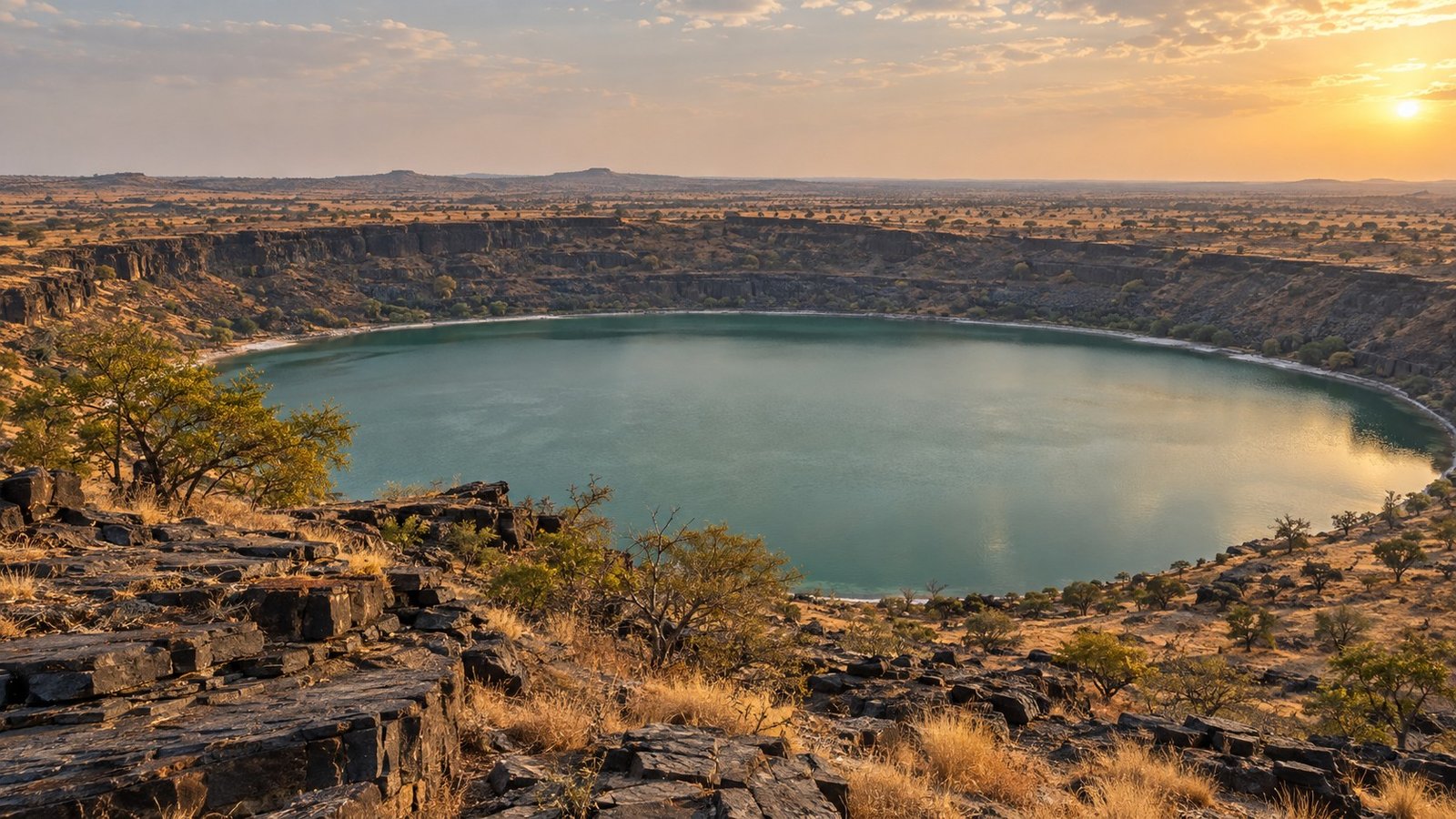
Lonar lies in Buldhana district, Maharashtra, within the basaltic Deccan Traps. It formed through a high-velocity meteorite impact, not an ordinary volcanic eruption. The IUGS book gives the crater an approximate diameter of 1.88 km. The lake at its centre and the whole crater have different dimensions; lake width at the water level should not be substituted for crater diameter.
IUGS describes Lonar as one of five hypervelocity meteorite impact craters on Earth formed in basalt. It is therefore incorrect to call it the world's only basalt impact crater. Impact glass, fragmented rocks, breccia and ejected material help researchers reconstruct its formation.
Wetland importance
The Convention on Wetlands describes Lonar as an almost circular, closed basin on the Deccan Plateau, formed by meteorite impact on basalt bedrock. The site includes the lake, crater walls and forested areas. It became a Ramsar Wetland of International Importance in 2020. Its saline-alkaline environment and impact geology make it important to both ecology and geology.
Scientific and conservation value
Impact processes in basalt offer useful comparisons with planetary bodies such as the Moon and Mars. Pollution, encroachment, invasive species and unregulated tourism also require attention. Recognition should support scientific education, responsible visitation and protection of the site.
Examination distinctions
- An impact crater and a volcanic crater are not the same.
- Ramsar recognition concerns wetland importance; IUGS recognition concerns geological scientific importance.
- IUGS selection does not automatically put a site on the UNESCO World Heritage List.
- Salinity and alkalinity are distinct properties. No unverified fixed comparison with seawater salinity is used here.
Mains practice
Why should geoheritage protection and wetland management be integrated? Discuss with reference to Lonar.
Prelims practice
Consider: (1) Lonar is an impact crater in basalt. (2) IUGS recognition automatically confers UNESCO World Heritage status.
Answer and explanation
Answer: (a). The recognition systems are separate.
FAQ
Where is Lonar?
Buldhana, Maharashtra.
How did it form?
Through meteorite impact.
Is it the only basalt impact crater?
No. IUGS describes it as one of five such hypervelocity impact craters.
Sources: https://iugs-geoheritage.org/publications-dl/IUGS-THIRD-100-SITES-WEB-BOOK.pdf; https://iugs-geoheritage.org/the-third-100-iugs-geological-heritage-sites-have-been-announced/; https://www.ramsar.org/news/india-names-two-more-wetlands-international-importance