
News reference: 25 November 2026
Published: 28 November 2026
Prelims: Space, lunar exploration and India-Japan cooperation
In this article
Why in the News
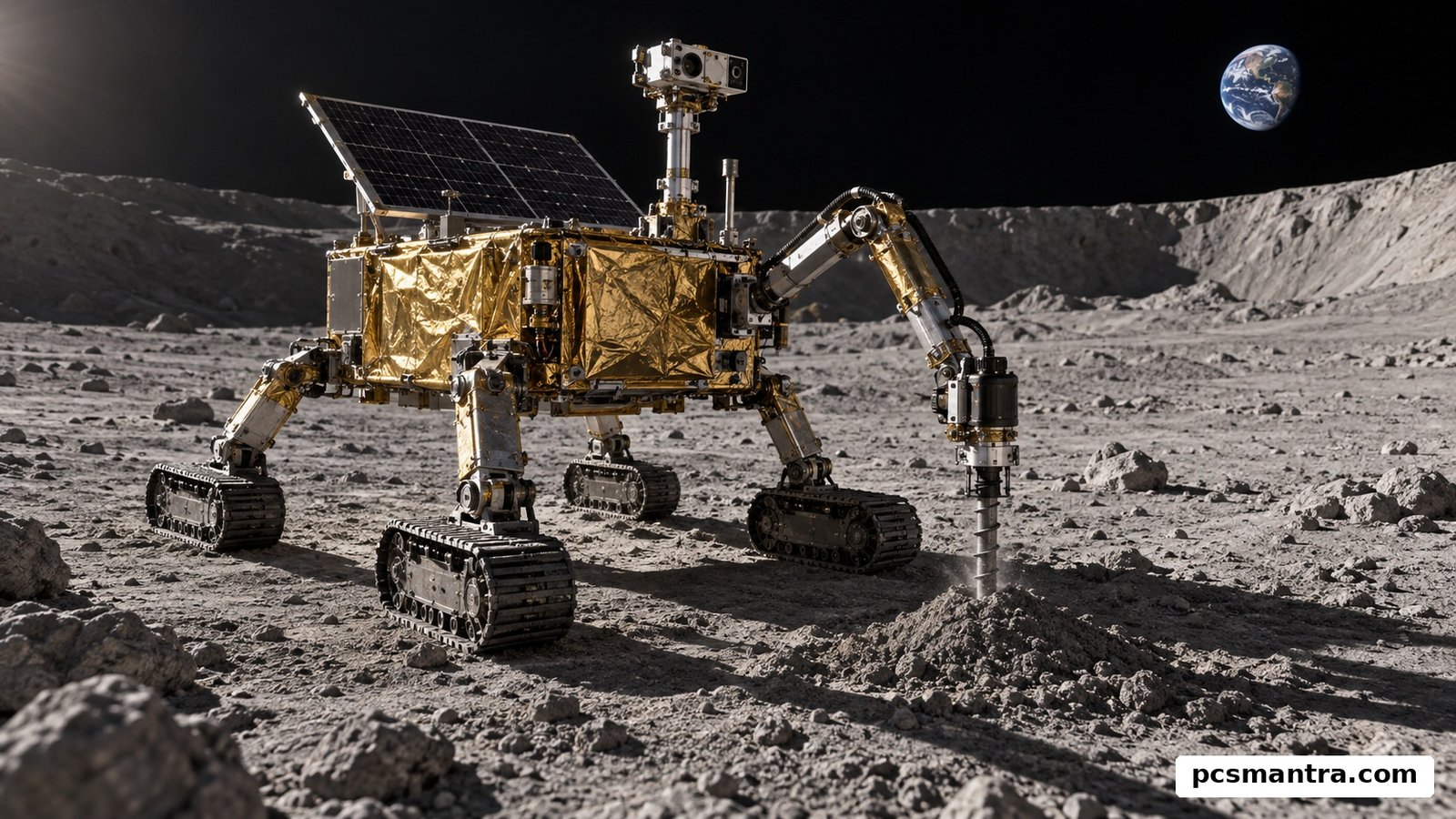
On 25 November 2026, the Japan Aerospace Exploration Agency (JAXA) unveiled the prototype of the rover for the Chandrayaan-5 mission at its Chofu Aerospace Centre in Tokyo, and demonstrated its mobility over simulated lunar terrain. This is a major milestone in Chandrayaan-5, also called LUPEX (Lunar Polar Exploration) — the first joint lunar mission of India and Japan, scheduled for launch in 2028 aboard Japan's H3 rocket.
Definition box — key terms
- Rover: an uncrewed vehicle that moves across a planetary surface collecting data.
- Lander: the module that lands safely and carries the rover.
- Permanently Shadowed Region (PSR): polar craters on the Moon that sunlight has never reached, where volatiles like water ice can survive.
- Regolith: the Moon's loose, fine dust-and-gravel surface layer.
- Payload: the scientific instruments carried on a mission.
- Volatiles: substances such as water and carbon dioxide that vaporise easily.
The Mission at a Glance
| Point | Detail |
|---|---|
| Mission name | Chandrayaan-5 / LUPEX (Lunar Polar Exploration) |
| Partners | ISRO (India) and JAXA (Japan) |
| Objective | Study water ice and volatiles on and below the surface near a PSR at the lunar south pole |
| Lander | Being built by ISRO |
| Rover | Being built by JAXA (with Mitsubishi Heavy Industries) |
| Launch | 2028, on Japan's H3-24L rocket from Tanegashima Space Centre |
| Launch mass | About 6.5 tonnes |
| Mission life | Nominal three and a half months, extendable up to one year |
| India's approval | Financial sanction on 10 March 2025 |
What Is Special About the Rover
- Weight and build: at about 350 kg, the rover stands on four legs with belt-like crawler tracks instead of wheels. In the demonstration it climbed over rocks and a mock crater.
- The challenge: polar regolith sinks like fresh snow and its grains are sharp enough to jam machinery. Crawlers spread the load, reducing sinking and slipping, while the four legs adapt to uneven ground.
- Two-tier exploration: first 'coarse' observations — mapping terrain and picking drilling spots; then 'fine' observations — drilling regolith from depths of up to 1.5 metres and analysing it.
- Instruments: the rover carries seven scientific instruments. The mission's 11 payloads come from ISRO, JAXA, the European Space Agency (ESA) and NASA — NASA's Neutron Spectrometer will look for subsurface hydrogen/water ice, while ESA's mass spectrometer (EMS-L) will study the Moon's extremely thin exosphere.
- Pre-planned path: after landing, the rover will follow a route mapped jointly by ISRO and JAXA for science operations, measurements and battery recharging.
Its Place in the Chandrayaan Series
- Chandrayaan-1 (2008): orbital survey; key role in finding water molecules on the Moon.
- Chandrayaan-2 (2019): the orbiter still works; the lander crashed.
- Chandrayaan-3 (2023): successful landing near the south pole on 23 August 2023 — Vikram lander and Pragyan rover did in-situ analysis.
- Chandrayaan-4: India's first lunar sample-return mission, approved.
- Chandrayaan-5/LUPEX: the first Indian mission to drill below the surface and directly measure the amount and spread of water ice — the next step from pinpoint landing to mobile exploration.
Why the Mission Matters
- Scientific: ice preserved in PSRs is a record of the early solar system; mapping its depth and purity would be the most direct evidence yet.
- Strategic/future readiness: lunar water enables in-situ resource utilisation (ISRU) — drinking water, breathable oxygen and rocket fuel. India aims to land its astronauts on the Moon by 2040; LUPEX's drilling technology is a building block.
- A model of international cooperation: an Indian lander, a Japanese rover and rocket, and instruments from four agencies — cost- and expertise-sharing makes big missions viable. This is the space dimension of the India–Japan Special Strategic and Global Partnership.
- Technical learning: the four-legged crawler, drilling system and tele-operations will feed into Chandrayaan-4 and future crew-support missions.
Challenges and Limits
- Technical risk: extreme polar temperatures, communication shadow, limited sunlight, and a hard landing-site choice near PSRs.
- Schedule: the 2028 date depends on the H3 rocket's record and schedule coordination between the two agencies.
- Balanced expectations: the prototype demo is a ground test; the flight model is in advanced testing — the demo alone is not mission success.
Way Forward
Success now hinges on flight-model testing, the lander-rover technical interface and the final landing-site selection. For India the mission tests scientific credibility, technical capacity and international partnership at once. LUPEX's data will draw the resource map for future crewed campaigns.
Prelims Practice Questions
Question 1. With reference to the Chandrayaan-5/LUPEX mission, consider the following statements:
Statement 1: The mission's lander is being developed by ISRO and the rover by Japan's space agency JAXA.
Statement 2: It is proposed to be launched on Japan's H3 rocket.
Statement 3: The mission will search for water ice in the Moon's equatorial region.
Which of the statements given above is/are correct?
Answer and explanation
Correct answer: (a)
Statement 1 is correct — ISRO is building the lander; JAXA (with Mitsubishi Heavy Industries) the rover.
Statement 2 is correct — launch is planned for 2028 on Japan's H3-24L rocket from Tanegashima.
Statement 3 is wrong — the target is not the equatorial region but the vicinity of a Permanently Shadowed Region at the lunar south pole.
Question 2. With reference to the Chandrayaan-5/LUPEX rover, consider the following statements:
Statement 1: It is a four-legged crawler rover rather than a conventional wheeled one.
Statement 2: It will be able to drill up to about 1.5 metres deep and analyse lunar regolith.
Statement 3: Its payloads include a neutron spectrometer from NASA.
Which of the statements given above is/are correct?
Answer and explanation
Correct answer: (d)
Statement 1 is correct — the demonstrated prototype has belt crawlers on four legs, which reduce sinking and slipping in regolith.
Statement 2 is correct — in the 'fine' observation phase the rover will drill to about 1.5 metres and analyse samples.
Statement 3 is correct — NASA's Neutron Spectrometer will search for subsurface hydrogen/water ice; ESA's EMS-L is also aboard.
Frequently Asked Questions (FAQ)
Are LUPEX and Chandrayaan-5 the same mission?
Yes. Chandrayaan-5 is the fifth mission of India's Chandrayaan series, and the joint India-Japan mission's technical name is LUPEX (Lunar Polar Exploration).
Is this rover like Chandrayaan-3's Pragyan?
No. Pragyan was a small wheeled rover limited to surface analysis; the LUPEX rover is about 350 kg, walks on four crawler legs and will drill up to 1.5 metres below the surface.
Why is water ice at the lunar south pole so important?
Ice in permanently shadowed craters may be preserved for aeons. It can become a local source of drinking water, oxygen and fuel for future crewed missions, so mapping its exact location and quantity is strategically vital.
Related Articles
- Chandrayaan-3 APXS study: the structure of Shiv Shakti point
- Chandrayaan-2's radar: signs of ice and their limits
- BepiColombo: a mission to understand Mercury with two craft
Sources
- [1] ISRO: ISRO-JAXA Technical Interface Meet (TIM-3), Chandrayaan-5/LUPEX — https://www.isro.gov.in/ISRO_JAXA_CH5_Technical_Interface_Meet.html
- [2] PIB, parliamentary answer on human spaceflight (3 December 2025) — https://www.pib.gov.in/PressReleasePage.aspx?PRID=2198265&lang=1®=3
- [3] Indian Express (27 November 2026) — https://indianexpress.com/article/india/handrayaan-5-jaxa-lunar-rover-prototype-lupex-mission-10980933/
- [4] The Hindu (26/27 November 2026) — https://www.thehindu.com/sci-tech/science/prototype-of-chandrayaan-5lupex-rover-unveiled/article71746762.ece
- [5] The Japan Times (26 November 2026) — https://www.japantimes.co.jp/news/2026/11/26/japan/science-health/jaxa-moon-rover/
Download this article: PDF