
Published: 26 November 2026
In this article
S.O. 6326(E), 20 November 2026 | Mains: GS3, Environment
Key facts
- Notification: Environment Protection (End-of-Life Vehicles) Amendment Rules, 2026, S.O. 6326(E), dated 20 November 2026
- Issued by: Ministry of Environment, Forest and Climate Change
- Parent rules: ELV Rules, 2025 (S.O. 98(E), 6 January 2025), in force from 1 April 2025
- Changes: two provisos added to sub-rule (6) of rule 4; one phrase omitted from sub-rule (2) of rule 9
- In force: from the date of publication in the Gazette
Introduction
On 20 November 2026 the Ministry of Environment, Forest and Climate Change issued S.O. 6326(E), amending the Environment Protection (End-of-Life Vehicles) Rules, 2025. The amendment changes only two places: sub-rule (6) of rule 4 and sub-rule (2) of rule 9.
Both rules sit inside the Extended Producer Responsibility (EPR) scheme. EPR means the maker who puts a product on the market stays responsible for its end-of-life handling. The ELV Rules apply this to vehicles.
What the 2025 rules said
Under rule 4(1) every producer must meet EPR for the vehicles it has introduced and meet the scrapping targets in the Schedule. It must register on the portal of the Central Board (the Central Pollution Control Board), file the previous year's annual return (Form 1) by 30 June, and declare the current year's EPR obligation by 30 April.
Rule 4(6) covered a producer that stops operations. It had to meet EPR for the vehicles already placed in the market until closure.
Rule 9 deals with EPR certificates. The Central Board issues them in favour of a Registered Vehicle Scrapping Facility (RVSF), and a producer can buy them on the portal to meet its obligation. Rule 9(2) based a certificate on the weight of steel recovered from ELVs processed at the RVSF, and also on "other steel scrap materials related to automobile sector" processed at the RVSF.
What the amendment changes
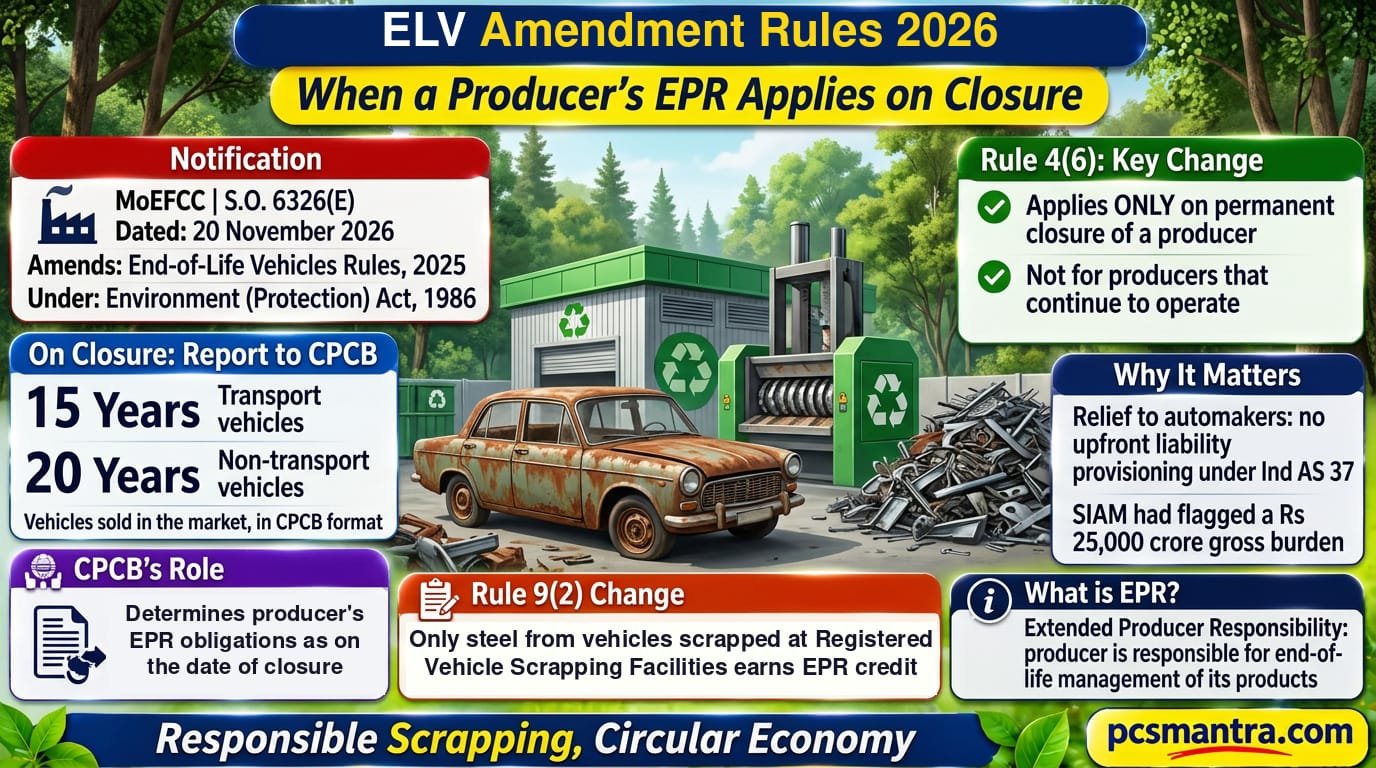
Rule 4(6), first proviso. Sub-rule (6) comes into operation only upon permanent cessation of operations by the producer. It does not apply to producers that continue to operate.
Rule 4(6), second proviso. At permanent cessation the producer informs the Central Board, in the Board's format, about the vehicles it introduced in the market in the preceding fifteen years for transport vehicles or twenty years for non-transport vehicles. The Board then determines and informs the producer's EPR obligations as on the date of cessation. While doing so it takes into account all applicable provisions.
Rule 9(2), omitted words. The words "or other steel scrap materials related to automobile sector processed at Registered Vehicle Scrapping Facility" are omitted. A certificate is now based on steel recovered from ELVs processed at the RVSF.
Before and after
| Point | Before (ELV Rules 2025) | Now (Amendment 2026) |
|---|---|---|
| Rule 4(6) | A producer that stops operations meets EPR for vehicles placed in the market until closure | Applies only on permanent closure, not to continuing producers; at closure the producer reports 15 years (transport) or 20 years (non-transport) of vehicles to the Board |
| Closure obligation | The sub-rule only requires EPR to be met for vehicles placed until closure | Board fixes and informs the obligation as on the date of cessation |
| Rule 9(2) | Certificate basis: steel from ELVs plus other automobile-sector steel scrap processed at the RVSF | Certificate basis: steel recovered from ELVs processed at the RVSF |
| Rule 4(1) | Annual EPR, 30 June and 30 April deadlines | Unchanged |
What has not changed
The amendment does not touch rule 4(1). For producers that keep operating, registration, the 30 June annual return, the 30 April declaration and the Schedule targets stay as they were. The new proviso only says that the closure sub-rule (6) does not apply to them. Reading it as a waiver of annual EPR would be wrong.
The fifteen and twenty year windows are used only for the information given at closure. The Board's format and the method of working out the obligation are not in the notification. The notification also gives no reason, so the purpose of the change cannot be read from the text.
Where the process stands
The draft of this amendment was published on 27 March 2026 as S.O. 1619(E), inviting objections and suggestions within sixty days. The final notification records that all objections and suggestions received were considered. The final text is the one that counts, not the draft. The rules are in force from the date of publication.
Conclusion
The amendment does two things. It makes the exit case clear: on permanent closure the producer reports the vehicles it placed in the market and the Board fixes the obligation as on that date. And it narrows the basis of EPR certificates to steel from ELVs. For producers still operating, the annual duties are unchanged.
Mains Practice
Examine the obligations of vehicle producers under the Extended Producer Responsibility framework in the ELV Rules, 2025, in light of the November 2026 amendment. (250 words, 15 marks)
Answer outline
Introduction
Explain EPR and briefly introduce rules 4 and 9 of the ELV Rules 2025. Mention S.O. 6326(E).
Main body
State the duties of operating producers under rule 4(1): registration, the 30 June return, the 30 April declaration, Schedule targets. Then explain the two provisos to 4(6), the 15 and 20 year reporting, and the Board's determination. Explain how the words omitted from rule 9(2) affect the certificate basis. Note that the format and method of determination are not in the notification.
Conclusion
Point to the clarity gained for closure cases and the need for the Board's format, and restate that operating producers' duties are unchanged.
Prelims Practice
1. With reference to the ELV Amendment Rules, 2026, consider the following statements:
- As per the proviso, rule 4(6) comes into operation only when a producer permanently ceases operations.
- The amendment exempts producers that continue to operate from the annual EPR duties of rule 4(1).
- On permanent cessation, a producer must inform the Central Board about vehicles introduced in the preceding fifteen years for transport vehicles and twenty years for non-transport vehicles.
Which of the statements given above are correct?
Answer and explanation
Answer: (b)
Statement 1 is correct: the first proviso makes sub-rule (6) operative only on permanent cessation.
Statement 2 is incorrect: rule 4(1) is not amended. The proviso only says sub-rule (6) does not apply to continuing producers.
Statement 3 is correct: the second proviso sets fifteen years for transport and twenty years for non-transport vehicles.
2. Which one of the following is correct about rule 9(2) of the ELV Rules, 2025 after the amendment?
Answer and explanation
Answer: (c)
Option (c) is correct: only the words on other steel scrap materials were omitted, so the basis is steel from ELVs.
Option (a) is incorrect because exactly those words were omitted.
Option (b) is incorrect: under rule 9(1) the certificate is issued in favour of the RVSF and producers buy it on the portal.
Option (d) is incorrect: only some words were omitted and the sub-rule remains.
FAQ
In short: S.O. 6326(E) limits rule 4(6) to permanent closure and removes other steel scrap as a basis in rule 9(2). Operating producers keep their annual EPR duties.
Are operating producers exempt from annual EPR now?
No. Rule 4(1) is not amended. The new proviso only keeps the closure sub-rule (6) from applying to them. Registration, the 30 June return and the 30 April declaration stay as before.
What are the fifteen and twenty year windows for?
At permanent closure the producer informs the Central Board about vehicles introduced in the preceding fifteen years (transport) or twenty years (non-transport). The Board uses that to fix the obligation as on the date of closure.
What was removed from rule 9(2)?
The words on other steel scrap materials related to the automobile sector processed at the RVSF. A certificate is now based on steel recovered from ELVs processed at the RVSF.
Sources
- Gazette of India, Extraordinary, Part II Section 3(ii), No. 6086, 20 November 2026, S.O. 6326(E), CG-DL-E-24112026-278144: https://egazette.gov.in/WriteReadData/2026/278144.pdf
- Environment Protection (End-of-Life Vehicles) Rules, 2025, S.O. 98(E), 6 January 2025 (original rules 4 and 9): https://eprelv.cpcb.gov.in/static/doc/ELV_Rules_2025.pdf