
Published: 26 November 2026
In this article
Why in news
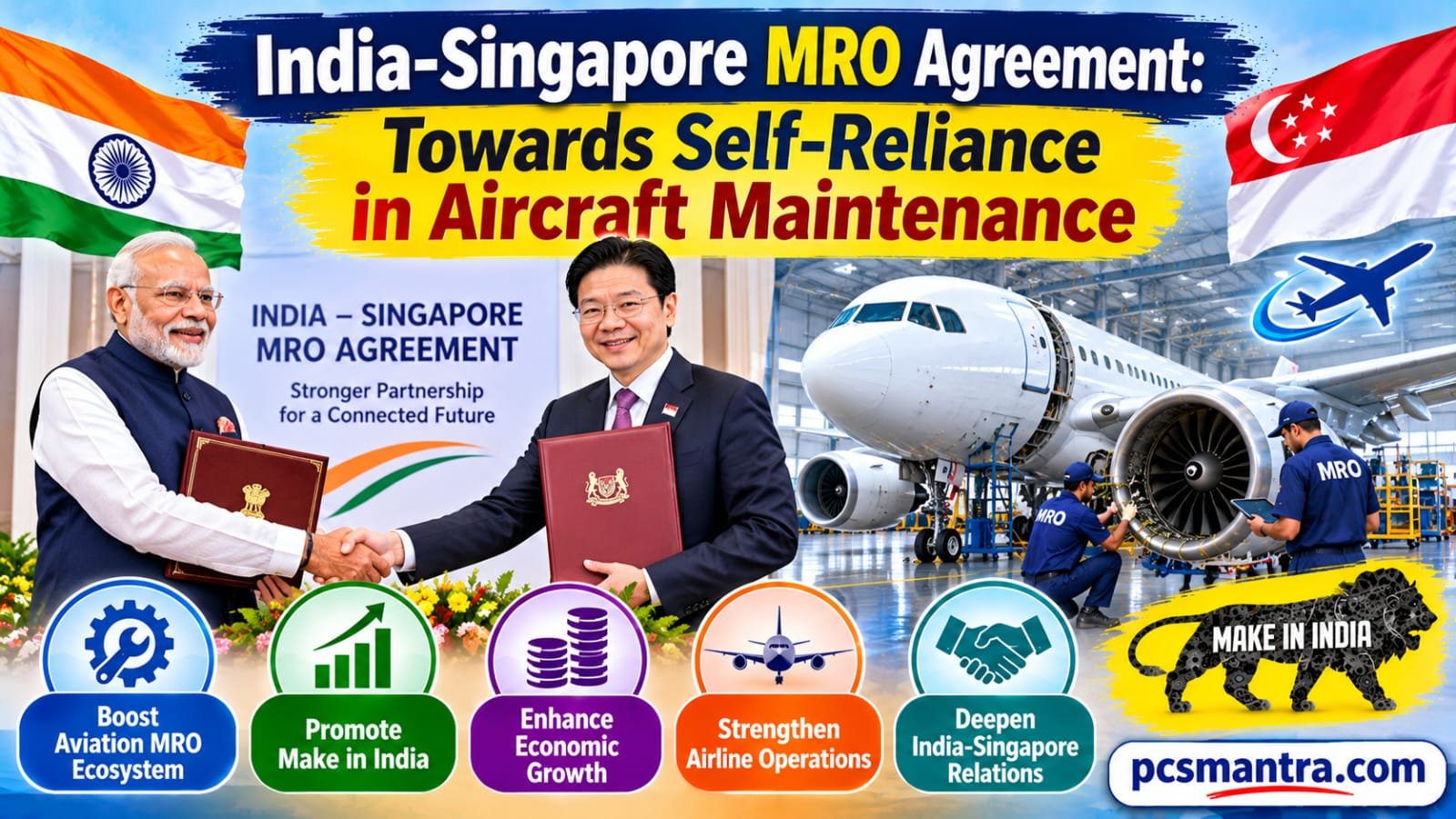
The Union Cabinet, chaired by the Prime Minister, on 25 November 2026 approved the signing of a Memorandum of Understanding (MoU) between India and the Republic of Singapore on cooperation in skills and industry development within the aviation Maintenance, Repair and Overhaul (MRO) sector. PIB reports Cabinet approval of the signing; no signing has been reported.
What MRO and AME mean
MRO stands for Maintenance, Repair and Overhaul, the scheduled inspection, upkeep, repair and complete overhaul of an aircraft and its components. It covers every part, from landing gear, engines and radomes (the protective nose cover over radar) to cockpit displays, seats and wings. An Aircraft Maintenance Engineer (AME) is the trained technical professional who inspects an aircraft and certifies its airworthiness.
Key provisions of the MoU
- Joint curriculum development: An industry-oriented curriculum for AME training will be developed jointly.
- Capacity building of institutes: Expertise will be shared so that Indian institutes can deliver the curriculum with quality.
- Internships and exchanges: Programmes with Singapore MRO entities will give Indian students practical industry experience.
- Industry partnerships: Partnerships between Indian and Singaporean industry stakeholders will be facilitated to support the expansion of MRO facilities.
Why India needs domestic MRO
India is among the world's fastest-growing aviation markets and airlines are steadily expanding their fleets, creating rising demand for domestic MRO capability and skilled AMEs. According to Civil Aviation Minister Ram Mohan Naidu, dependence on overseas maintenance services often results in higher costs and longer aircraft downtime for airlines, and the goal is for every component, from landing gear to engines and cockpit displays, to be repaired in India and for India to be positioned as the regional aviation workshop.
A complementary partnership
Singapore has a well-established aviation MRO ecosystem, while India's aviation market is expanding rapidly. A growing fleet, India's strategic geographical position as a regional aviation hub, and government efforts to improve the ease of doing business make the two sides complementary. The cooperation provides a framework for exchanging knowledge, expertise and best practices.
Expected gains
Skilled workforce: Indian training institutions will strengthen their curriculum and training capability, creating skilled employment for youth.
Domestic infrastructure: Greater industry participation is expected to support the development of MRO facilities in India.
Lower dependence: Over time, dependence on overseas maintenance services is expected to reduce, a step towards Atmanirbhar Bharat.
Approval, signing and operation are distinct
An MoU is only a framework for cooperation. Cabinet approval does not mean the MoU has been signed or that any new MRO facility is operational. In exam answers, keep the three stages distinct: approval, signing and actual operation.
Way forward
After signing, institute-level partnerships, curriculum alignment and industry investment will need to be time-bound. Expanding the supply of AMEs and taking MRO facilities beyond the largest centres are the challenges ahead.
Prelims practice question
Question 1. Consider the following statements regarding the India-Singapore aviation MRO understanding:
Statement 1: The Union Cabinet on 25 November 2026 approved the signing of this Memorandum of Understanding.
Statement 2: The MoU was formally signed between the two countries on 25 November 2026 itself.
Which of the statements given above is/are correct?
Answer and explanation
Answer: (b).
Statement 1 is correct. The Cabinet approved the signing of the MoU on 25 November 2026.
Statement 2 is incorrect. PIB reports only Cabinet approval of the signing; no signing has been reported.
Mains practice question
What cost and operational problems do Indian airlines face in the absence of domestic MRO capacity? How can India-Singapore cooperation help close this gap? (250 words, 15 marks)
Answer outline
- Introduction
Define MRO and open with the Cabinet decision of 25 November 2026.
- Main body
Cover the cost and downtime burden of overseas maintenance, the growing fleet and AME demand, and the potential improvement through the MoU's four provisions (curriculum, institute capacity, internships, industry partnerships).
- Conclusion
Keep approval, signing and operation distinct, and close on implementation; link becoming a regional MRO hub to self-reliance.
Sources
Frequently asked questions
Has the India-Singapore MRO MoU been signed?
No. PIB reports that the Cabinet on 25 November 2026 approved the signing of the MoU; no signing has been reported.
What does MRO stand for?
Maintenance, Repair and Overhaul: the inspection, upkeep, repair and complete overhaul of aircraft and their components.
What does the MoU provide on training?
A jointly developed industry-oriented AME curriculum, capacity building of Indian institutes, and internship and exchange programmes with Singapore MRO entities.
Download this article: PDF