
Published: 26 November 2026
In this article
Why in news
On 25 November 2026, Maharashtra's Department of Food, Civil Supplies and Consumer Protection issued a government resolution (GR) under which farmers who receive neither foodgrain under the National Food Security Act (NFSA) nor the cash benefit of the APL-DBT scheme will get free foodgrain for three months. The decision follows the state Cabinet's decision taken the same day.
What the government resolution says
The benefit: each eligible person will get 5 kg of grain per month (3 kg of rice and 2 kg of wheat) free of cost, for three months.
Coverage: according to the resolution, the benefit reaches 42,30,783 farmers (members of farmer families) across 33 districts, at 5 kg per person per month. Three urban districts, Mumbai City, Mumbai Suburban and Thane, are excluded.
What happens next: whether distribution continues after three months will be decided with the Chief Minister's approval.
Who is eligible
The eligibility in the resolution is precise. Beneficiaries are farmers who get neither NFSA foodgrain nor the APL-DBT cash benefit. The resolution cites inflation figures as the basis for the decision. The GR does not mention drought or any means test. Reading it as a general below-poverty-line scheme or a drought-relief scheme would be incorrect.
How distribution will work
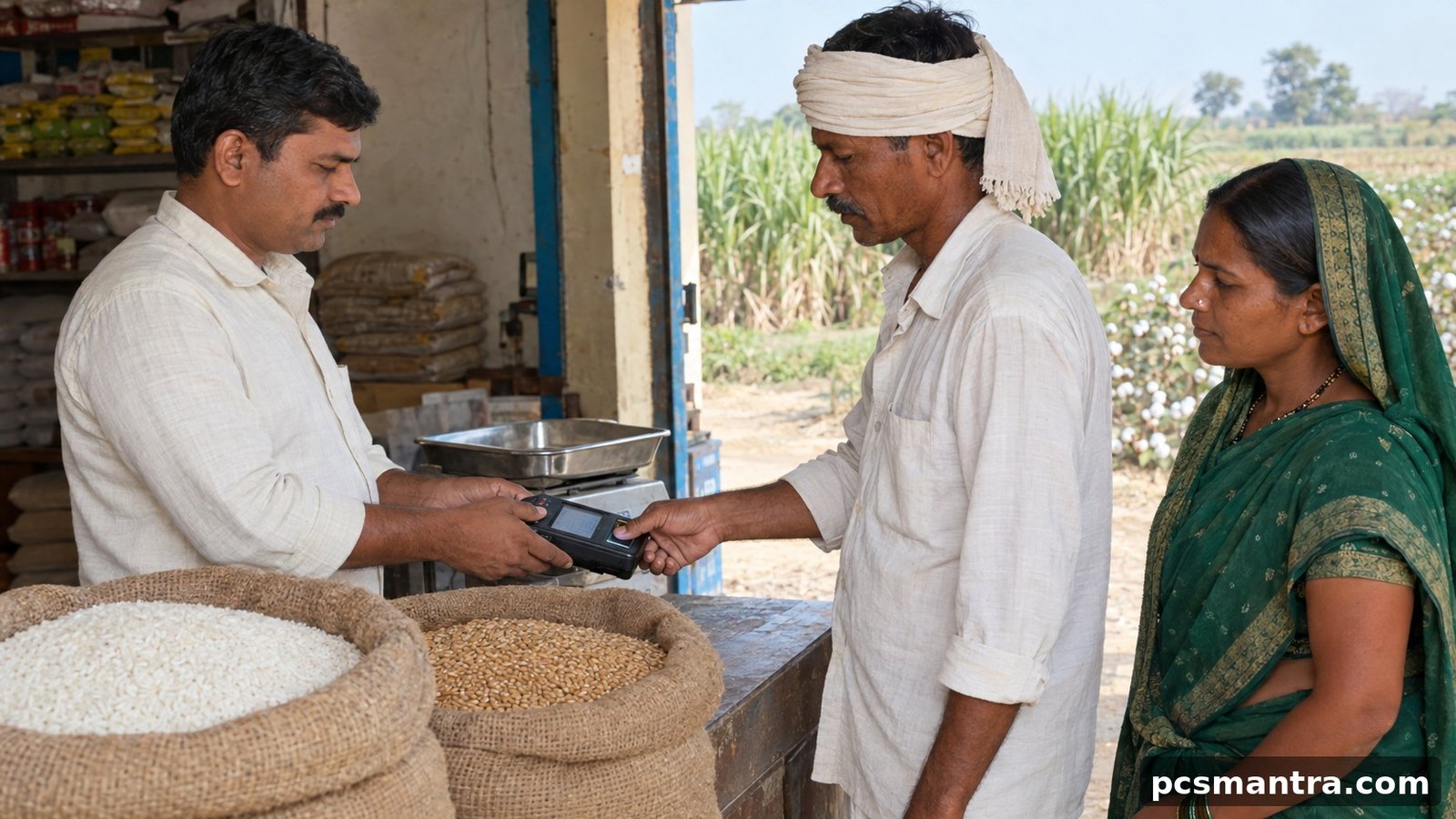
Biometric verification: ration-card holders whose Aadhaar seeding is complete will receive grain after biometric authentication on e-PoS machines.
Remaining beneficiaries: those whose Aadhaar seeding is incomplete must first complete it; grain will then be distributed to them through biometric verification.
Request to the Centre: the state will request the additional grain allocation needed for this free distribution from the Union Ministry of Consumer Affairs, Food and Public Distribution.
The financial arrangement
Available funds: a total of Rs 2,387.80 crore is available in FY 2026-27: Rs 2,322.14 crore for grain purchase and distribution, and Rs 65.66 crore for incidental expenses. The actual cost variations from the purchase process and from changes in the number of beneficiaries have also been approved. The 2027-28 cost will be met from that year's budget provision.
Related concepts
NFSA: the National Food Security Act, 2013 provides for subsidised foodgrain for up to 75 per cent of the rural and 50 per cent of the urban population (PIB).
e-PoS: the electronic point-of-sale device at ration shops, which dispenses grain after Aadhaar-linked biometric authentication.
APL-DBT: a Maharashtra government scheme that pays Rs 150 per beneficiary per month directly into bank accounts instead of grain (the 2023 rate; revised yearly per the department). It is for APL (saffron ration card) farmers in 14 drought-prone districts: all districts of the Aurangabad (Chh. Sambhajinagar) and Amravati divisions, and Wardha in the Nagpur division (Maharashtra food department).
Analysis for the exam
The inflation background: the resolution cites October 2026 data from the Ministry of Statistics and Programme Implementation. Retail inflation in India was 6.09 per cent and food inflation 8.94 per cent. Maharashtra's average inflation was 5.85 per cent, with rural inflation (6.86 per cent) higher than urban inflation (5.20 per cent). This is why the decision focuses on rural farming families.
The targeting lesson: the decision shows a gap in the food security framework, where some families fall between NFSA and the state's cash scheme.
The limits: the relief is temporary, only three months, and procedural issues such as identification and Aadhaar seeding can affect last-mile delivery.
Way forward
The real test of this decision will be how accurately eligible farmers are identified, whether beneficiaries stuck in Aadhaar seeding receive grain on time, and whether, after three months, the state extends the relief or finds these families a place in a structural arrangement such as NFSA.
Prelims practice question
Question 1. Consider the following statements regarding Maharashtra's recent government resolution:
Statement 1: Each eligible person will receive 5 kg of grain free per month, comprising 3 kg of rice and 2 kg of wheat.
Statement 2: The benefit applies to all districts of the state, including Mumbai City, Mumbai Suburban and Thane.
Statement 3: Beneficiaries will receive grain after biometric verification on e-PoS machines.
Which of the statements given above are correct?
Answer and explanation
Answer: (b).
Statement 1 is correct: the benefit is 5 kg per person per month, 3 kg of rice and 2 kg of wheat, free of cost. Statement 2 is incorrect: Mumbai City, Mumbai Suburban and Thane are excluded; 33 districts are covered. Statement 3 is correct: ration-card holders with completed Aadhaar seeding will get grain after biometric authentication on e-PoS machines.
Question 2. Under this decision of Maharashtra, who will receive free foodgrain?
Answer and explanation
Answer: (d).
The resolution's eligibility is precise: the 42,30,783 farmers in 33 districts who receive neither NFSA foodgrain nor the APL-DBT cash benefit. The GR does not mention drought or any means test, so it cannot be described as a general BPL or drought-relief scheme.
Mains practice question
Question 1. "Maharashtra's free-grain decision is an attempt to fill a gap left in the food security structure." Examine this statement with reference to the resolution's eligibility, distribution system and financial arrangement. (250 words, 15 marks)
Answer outline
Introduction: the date of the government resolution, the inflation background and the essence of the decision in brief.
Body: the precise eligibility (farmers excluded from both NFSA and APL-DBT); 33 districts and 42,30,783 beneficiaries; the 5 kg per month benefit; e-PoS biometric distribution; the request to the Centre for additional allocation; the Rs 2,387.80 crore financial arrangement; the temporary nature of the relief and implementation challenges.
Conclusion: a balanced assessment of the statement: a commendable gap-filling step, but correct identification, Aadhaar seeding and a long-term institutional solution remain necessary.
Sources
- https://gr.maharashtra.gov.in/Site/Upload/Government%20Resolutions/Marathi/202611251846448706.pdf (Government of Maharashtra, Resolution No. Adhapu-2026/Pra.Kra.52/Na.Pu.22, 25 November 2026)
- https://mahafood.gov.in/en/scheme/apl-farmer
- https://www.pib.gov.in/PressReleasePage.aspx?PRID=1897933&lang=2®=3
Frequently asked questions
What is the essence of Maharashtra's government resolution?
Farmers in 33 districts who are excluded from both NFSA and APL-DBT, 42,30,783 in number, will receive 5 kg of grain per month (3 kg rice, 2 kg wheat) free for three months.
Which districts are outside this decision?
Three urban districts: Mumbai City, Mumbai Suburban and Thane.
What happens after three months?
Whether grain distribution continues after the three-month period will be decided with the Chief Minister's approval.
How much will this arrangement cost?
A total of Rs 2,387.80 crore is available for FY 2026-27, covering purchase, distribution and incidental expenses.
Download this article: PDF