
Published: 26 November 2026
In this article
Taprobanica, 25 November 2026 | Prelims: Biodiversity
Key facts
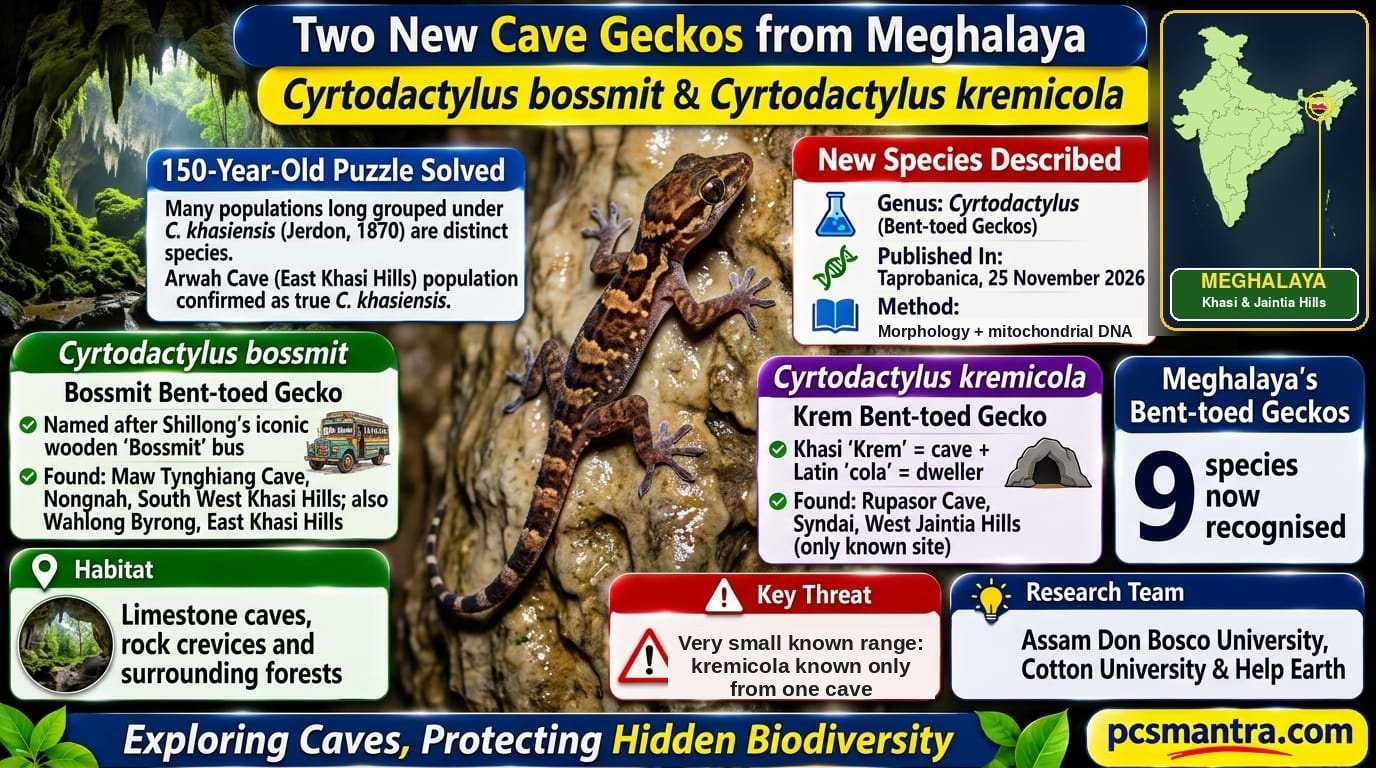
- Two new species: Cyrtodactylus bossmit and Cyrtodactylus kremicola (bent-toed geckos)
- Place: limestone caves of the Khasi and Jaintia Hills, Meghalaya
- Basis: morphological characters and the mitochondrial ND2 gene
- Recognised Cyrtodactylus species in Meghalaya: now nine
- Paper: Taprobanica, vol. 15, no. 2, pp. 466 to 483, published 25 November 2026
Introduction
Researchers have described two new bent-toed geckos of the genus Cyrtodactylus from limestone caves in the Khasi and Jaintia Hills of Meghalaya. The paper was published on 25 November 2026 in the journal Taprobanica. With these, the number of recognised Cyrtodactylus species in Meghalaya rises to nine.
The authors are from Assam Don Bosco University, Cotton University and the Guwahati-based Help Earth.
The two new species
Cyrtodactylus bossmit (Bossmit bent-toed gecko). The holotype is from Maw Tynghiang Cave, Nongnah Village, South West Khasi Hills District. It is also recorded at Wahlong Byrong in East Khasi Hills. The name refers to "Bossmit", the traditional wooden bus of Shillong. The paper says the name honours a cultural emblem and is not directly tied to the type locality. In East Khasi Hills it occurs alongside the population that matches the true C. khasiensis.
Cyrtodactylus kremicola (Krem bent-toed gecko). The holotype is from Rupasor Cave, Syndai Village, West Jaintia Hills. It is known so far only from this type locality. The name combines the Khasi word "krem" (cave) and the Latin "cola" (dweller), so "cave dweller".
How the species were told apart
The study used an integrative approach: body characters and a phylogeny built from the mitochondrial NADH dehydrogenase subunit 2 (ND2) gene, read together. Characters compared include precloacal pore counts, rows of dorsal tubercles, mid-ventral scale rows, paravertebral tubercle counts, snout-vent length and dorsal pattern.
Genetic gaps are given as uncorrected pairwise p-distances. Between the bossmit population and the Arwah Cave population it is 6.4 to 7.6 per cent. Between kremicola and bossmit it is 4 to 5.7 per cent, and between kremicola and the Arwah population 5.5 to 6.4 per cent.
Clarifying C. khasiensis
C. khasiensis was described by Jerdon in 1870 from the Khasi Hills, and the name was long applied to many similar populations across north-east India. This study finds that those populations hid several independently evolving lineages.
The Arwah Cave population in East Khasi Hills matches the name-bearing type series (lectotype and paralectotypes) in morphology. So the true C. khasiensis is currently known only from Arwah Cave, and the paper gives its first genetically validated reference. Populations from the Sohra and Umdohlun areas, earlier treated as C. khasiensis, are now referred to C. bossmit.
Why it matters
The paper calls the Khasi and Jaintia Hills an important centre of micro-endemism within the Indo-Burma biodiversity hotspot. In its account, limestone (karst) terrain supports narrowly distributed gecko lineages. The authors add that the region is still under-surveyed and that integrative surveys should continue.
The paper also says Cyrtodactylus, with about 398 described species, is regarded as the third most speciose vertebrate genus.
Conclusion
The finding shows that classification by appearance alone can miss hidden diversity. Morphology and DNA together fixed the limits of an old species and added two new ones.
Mains Practice
Explain the importance of the integrative taxonomic approach in biodiversity assessment with the example of the recent gecko discovery in Meghalaya. (150 words, 10 marks)
Answer outline
Introduction
State that integrative taxonomy reads morphological and genetic evidence together. Mention the two new Cyrtodactylus species from Meghalaya in November 2026.
Main body
Explain that matching the ND2 gene with morphology separated several lineages within the old C. khasiensis. Give the example of C. khasiensis being restricted to the Arwah population. Add the micro-endemism of the Khasi and Jaintia Hills and the need for more surveys.
Conclusion
Say that accurate species limits come first for conservation planning, and that surveys should continue.
Prelims Practice
1. With reference to the recently described Cyrtodactylus species from Meghalaya, consider the following statements:
- Two new species have been described from limestone caves of the Khasi and Jaintia Hills.
- The identification used morphological characters along with the mitochondrial ND2 gene.
- With these, the recognised Cyrtodactylus species of Meghalaya number nine.
Which of the statements given above are correct?
Answer and explanation
Answer: (d)
Statement 1 is correct: both species are described from limestone cave populations in the Khasi and Jaintia Hills.
Statement 2 is correct: the integrative method combined morphological characters with ND2 gene evidence.
Statement 3 is correct: the paper puts the number at nine.
2. According to the paper, which one of the following is correct about the true C. khasiensis?
Answer and explanation
Answer: (a)
Option (a) is correct: the Arwah Cave population matches the name-bearing type series.
Option (b) is incorrect: Syndai Village is the type locality of C. kremicola.
Option (c) is incorrect: C. bossmit is a separate new species.
Option (d) is incorrect: the paper says many older records rest on external morphology and lack genetic validation.
FAQ
In short: Cyrtodactylus bossmit and C. kremicola were described from Meghalaya's limestone caves. The state's recognised species now number nine.
Why is the gecko called bossmit?
After "Bossmit", Shillong's traditional wooden bus, a cultural symbol of shared journeys in the Khasi community. The paper says the bus has no direct link with the species' type locality.
How were the species told apart?
By reading morphological characters (for example precloacal pore counts and rows of dorsal tubercles) together with a phylogeny of the mitochondrial ND2 gene.
What did the study conclude about the Arwah Cave population?
It matches the name-bearing type series of C. khasiensis, so it is treated as the true C. khasiensis, with the first genetically validated reference.
Sources
- Umlong, C. M. et al. (2026). Two new limestone cave-dwelling gecko species (Reptilia: Gekkonidae: Cyrtodactylus) from Meghalaya, India, with comments on C. khasiensis (Jerdon, 1870). Taprobanica 15(2): 466 to 483, DOI 10.47605/tapro.v15i2.446: https://www.taprobanica.org/Archives/volume-15-20-2026-31/volume-15-number-2-2026/v15i2-446.html
Download this article: PDF