
News date: 25 November 2026 | Published: 26 November 2026
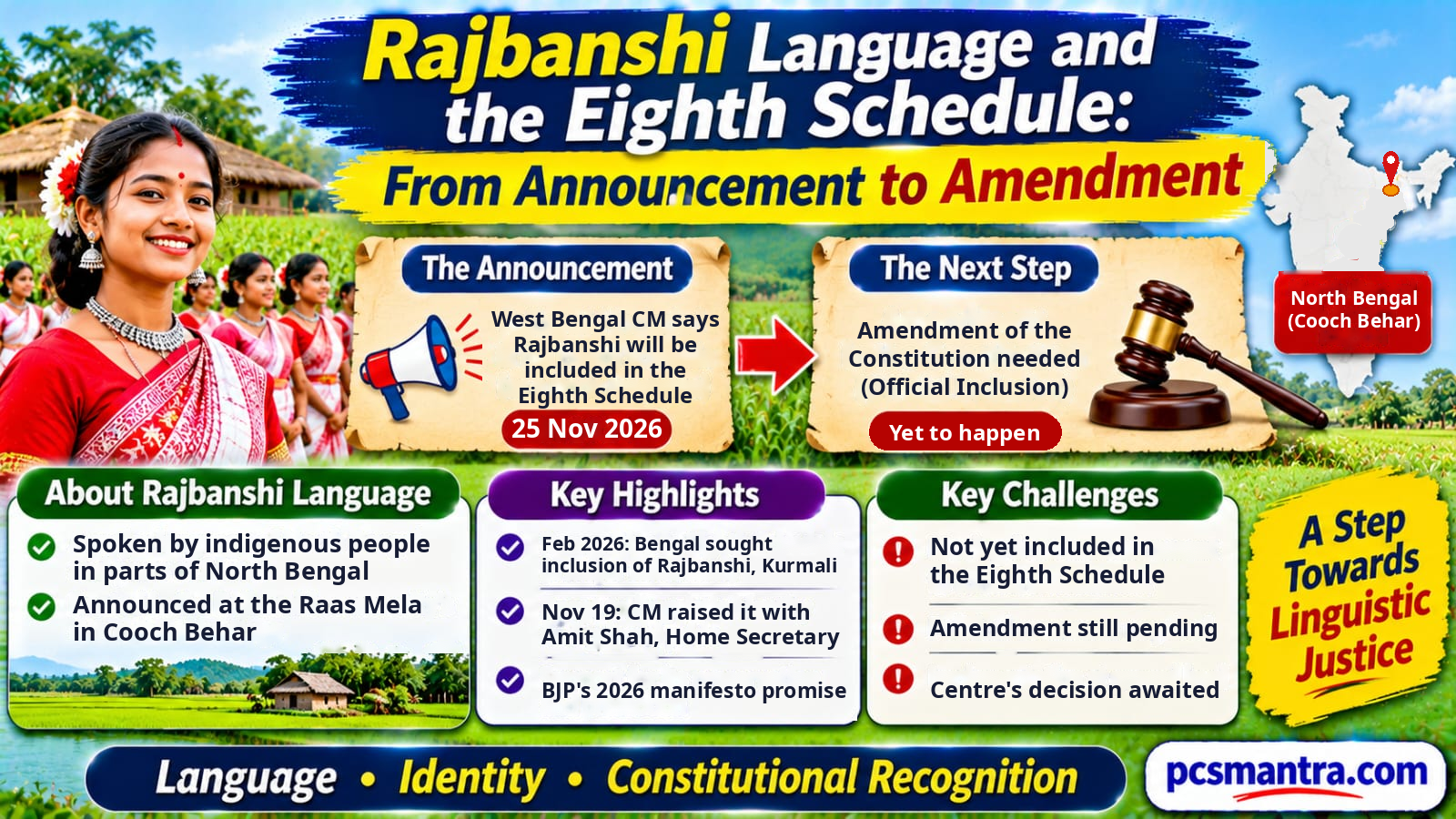
News context: West Bengal Chief Minister Suvendu Adhikari said in Cooch Behar on Wednesday, 25 November 2026, that the Rajbanshi language will be included in the Eighth Schedule of the Constitution. This was a BJP promise in the 2026 Assembly election campaign. It is a political announcement, not a constitutional amendment: a language enters the Eighth Schedule only when Parliament passes a constitutional amendment. [1]
Exam context: The Eighth Schedule is a regular exam topic: the number of languages, the years of inclusion, the related articles and the process of inclusion. Confusing an 'announcement' with an 'inclusion' is a familiar trap.
Prelims: Eighth Schedule, Articles 344, 345, 351 and 368
Mains: General Studies II: Indian Constitution: Schedules, amendment procedure; official language and language policy
In this article
Why in News
Before inaugurating the Ras Utsav festivities in Cooch Behar, the Chief Minister told reporters that the Rajbanshi language will be included in the Eighth Schedule. He said the issue was raised at a meeting on 19 November with the Union Home Minister and the Home Secretary, attended by him and the state's Chief Secretary. This is recorded as the Chief Minister's statement. [1]
Earlier, according to a news report, the state's Chief Secretary wrote to the Union Home Secretary on 19 February 2026 (before the 2026 Assembly election) with a formal proposal to include Rajbanshi and Kurmali in the Eighth Schedule. According to the report, the state has recognised both languages as official languages in areas where their speakers exceed a set share of the population. [4]
What is the Eighth Schedule
The Eighth Schedule lists the languages recognised by the Constitution. It is connected to Articles 344(1) and 351. Under Article 344(1), the Official Language Commission consists of members representing the different languages specified in the Eighth Schedule. [5] Article 351 makes it the Union's duty to promote Hindi and enrich it by assimilating, without interfering with its genius, the forms, style and expressions used in Hindustani and the other Eighth Schedule languages. [8]
According to the Ministry of Home Affairs (Lok Sabha reply of 14 March 2023), the Eighth Schedule has 22 languages. They were added in this order: [2]
| When | Which languages | Number |
|---|---|---|
| 26 January 1950 (at commencement) | Assamese, Bengali, Gujarati, Hindi, Kannada, Kashmiri, Malayalam, Marathi, Odia (Oriya), Punjabi, Sanskrit, Tamil, Telugu, Urdu | 14 |
| 10 April 1967 | Sindhi | 1 |
| 31 August 1992 | Konkani, Manipuri, Nepali | 3 |
| 7 January 2004 | Bodo, Dogri, Maithili, Santhali | 4 |
The Rajbanshi case: where it stands
- Status: There is an announcement and a proposal from the state, but no inclusion. [1] [4]
- The question of the name: The Ministry of Home Affairs' 2023 list of pending demands names 'Kamtapuri'; 'Rajbanshi' does not appear in it as a separate entry. [2] In the Rajya Sabha on 11 December 2025 the item was titled 'Demand for Recognition of Kurmali and Rajbanshi-Kamtapuri Languages in Eighth Schedule to the Constitution', and the member demanded that the 'Rajbanshi and Kamtapuri languages' be included in the Eighth Schedule. [9] We did not find in the sources how the Ministry treats these two names, so this article does not call them one language.
- State-level recognition: A State's official language status falls under Article 345, under which, subject to articles 346 and 347, the State Legislature may by law adopt any one or more of the languages in use in the State, or Hindi, for official purposes. [6] This is different from the Eighth Schedule.
The process and the difficulty
No fixed criteria: On 28 July 2026 the Ministry of Home Affairs told the Lok Sabha that there are no fixed criteria for including a language in the Eighth Schedule. The evolution of dialects and languages is dynamic, so it is difficult to fix criteria. The earlier attempts through the Pahwa (1996) and Sitakant Mohapatra (2003) Committees were inconclusive. For this reason no time-frame can be fixed for considering the demands. [3]
Constitutional amendment: Any change in the Eighth Schedule is made only by a constitutional amendment. Under Article 368(2) the Bill must be passed by a majority of the total membership of each House and by a two-thirds majority of members present and voting. The matters in the proviso that also need ratification by the legislatures of half the States (such as the Lists in the Seventh Schedule) do not include the Eighth Schedule. [7]
Pending demands: The Ministry's 2023 list contained 38 languages whose inclusion has been demanded, such as Bhojpuri, Rajasthani, Tulu, Garhwali, Kumaoni and Kamtapuri. [2]
Way Forward
Until criteria are fixed, every demand will be weighed on political and emotional grounds. Transparent criteria, expert opinion of language specialists and objective measures such as the number of speakers are therefore needed. Until then States can promote their languages at State level under Article 345, but the Eighth Schedule status can come only through an amendment by Parliament.
Prelims Practice Questions
Question 1. With reference to the Eighth Schedule of the Constitution of India, consider the following statements:
Statement 1: An announcement by a Chief Minister that a language will be included in the Eighth Schedule automatically changes the Schedule.
Statement 2: A constitutional amendment is necessary to add a language to the Eighth Schedule.
Statement 3: The Constitution lays down clear, fixed criteria for including languages in the Eighth Schedule.
Which of the statements given above is/are correct?
Answer and explanation
Answer: (b)
Statement 1 is incorrect: an announcement or promise does not change the Schedule; the change comes through an amendment by Parliament. [1] [7]
Statement 2 is correct: the Eighth Schedule is part of the Constitution, so changing it needs an amendment under Article 368. [7]
Statement 3 is incorrect: according to the Ministry of Home Affairs there are no fixed criteria, and the attempts of the Pahwa (1996) and Sitakant Mohapatra (2003) Committees were inconclusive. [3]
Question 2. With reference to the inclusion of languages in the Eighth Schedule, consider the following statements:
Statement 1: Sindhi was included in 1967.
Statement 2: Konkani, Manipuri and Nepali were included together in 1992.
Statement 3: Bodo, Dogri, Maithili and Santhali were included in 2004.
Which of the statements given above are correct?
Question 3. Which one of the following languages is currently included in the Eighth Schedule of the Constitution?
Frequently Asked Questions (FAQ)
Has the Rajbanshi language been included in the Eighth Schedule?
No. On 25 November 2026 the West Bengal Chief Minister said the language will be included. That is an announcement. Inclusion needs Parliament to pass a constitutional amendment. [1] [7]
How many languages are in the Eighth Schedule now?
According to the Ministry of Home Affairs, 22. [2]
What are the criteria for adding a language to the Eighth Schedule?
There are no fixed criteria. The Ministry of Home Affairs said so in the Lok Sabha in July 2026, adding that the Pahwa (1996) and Sitakant Mohapatra (2003) Committees' attempts were inconclusive. [3]
Which articles are linked to the Eighth Schedule?
Articles 344(1) and 351. The first relates to the Official Language Commission and the second to the promotion and enrichment of Hindi. [5] [8]
Sources
- [1] Rajbanshi language to be included in Eighth Schedule of Constitution: Suvendu Adhikari (The Hindu, 26 Nov 2026): https://www.thehindu.com/news/national/west-bengal/rajbanshi-languageto-be-included-ineighth-schedule-of-constitutionsuvendu-adhikari/article71742836.ece
- [2] Ministry of Home Affairs, Lok Sabha Unstarred Question 2082 (14 March 2023), Inclusion of languages in Eighth Schedule: https://sansad.in/getFile/loksabhaquestions/annex/1711/AU2082.pdf
- [3] Ministry of Home Affairs, Lok Sabha Unstarred Question 1584 (28 July 2026), Inclusion of Bhojpuri (the reply states the general policy on inclusion): https://sansad.in/getFile/lsapps/loksabhaquestions/annex/188/AU1584_zVgL9g.pdf
- [4] News report: Bengal seeks Eighth Schedule status for Rajbanshi and Kurmali languages (The Telegraph, 23 Feb 2026): https://www.telegraphindia.com/west-bengal/kolkata/bengal-seeks-eighth-schedule-status-for-rajbanshi-and-kurmali-languages-prnt/cid/2148510
- [5] Constitution of India: Article 344: https://www.constitutionofindia.net/articles/article-344-commission-and-committee-of-parliament-on-official-language/
- [6] Constitution of India: Article 345: https://www.constitutionofindia.net/articles/article-345-official-language-or-languages-of-a-state/
- [7] Constitution of India: Article 368: https://www.constitutionofindia.net/articles/article-368-power-of-parliament-to-amend-the-constitution-and-procedure-therefor/
- [8] Constitution of India: Article 351: https://www.constitutionofindia.net/articles/article-351-directive-for-development-of-the-hindi-language/
- [9] Rajya Sabha, synopsis of proceedings (11 Dec 2025): demand for recognition of Kurmali and Rajbanshi-Kamtapuri languages: https://cms.rajyasabha.nic.in/UploadedFiles/Synopsis/SynopsisUpload/Session_269/English_111225.pdf
Download this article: PDF