
Published: 26 November 2026
In this article
Why in news
A social media video of heavy earth-moving machinery near Sheshnag Lake, on the Amarnath Yatra route in Anantnag district, Jammu and Kashmir, drew attention. The Border Roads Organisation (BRO) issued a statement on 23 November saying it was carrying out post-yatra works. On 25 November, the J&K Forest Minister said a 12-member team of officials had found no tampering or violations during an inspection. [3][4]
Note: claims differ on the work shown in the video, its location and its effect on the lake. This article does not treat the claim of either side as independently verified. Facts, statements by the parties and the wider ecological questions are kept separate.
Sheshnag Lake: a geographical profile
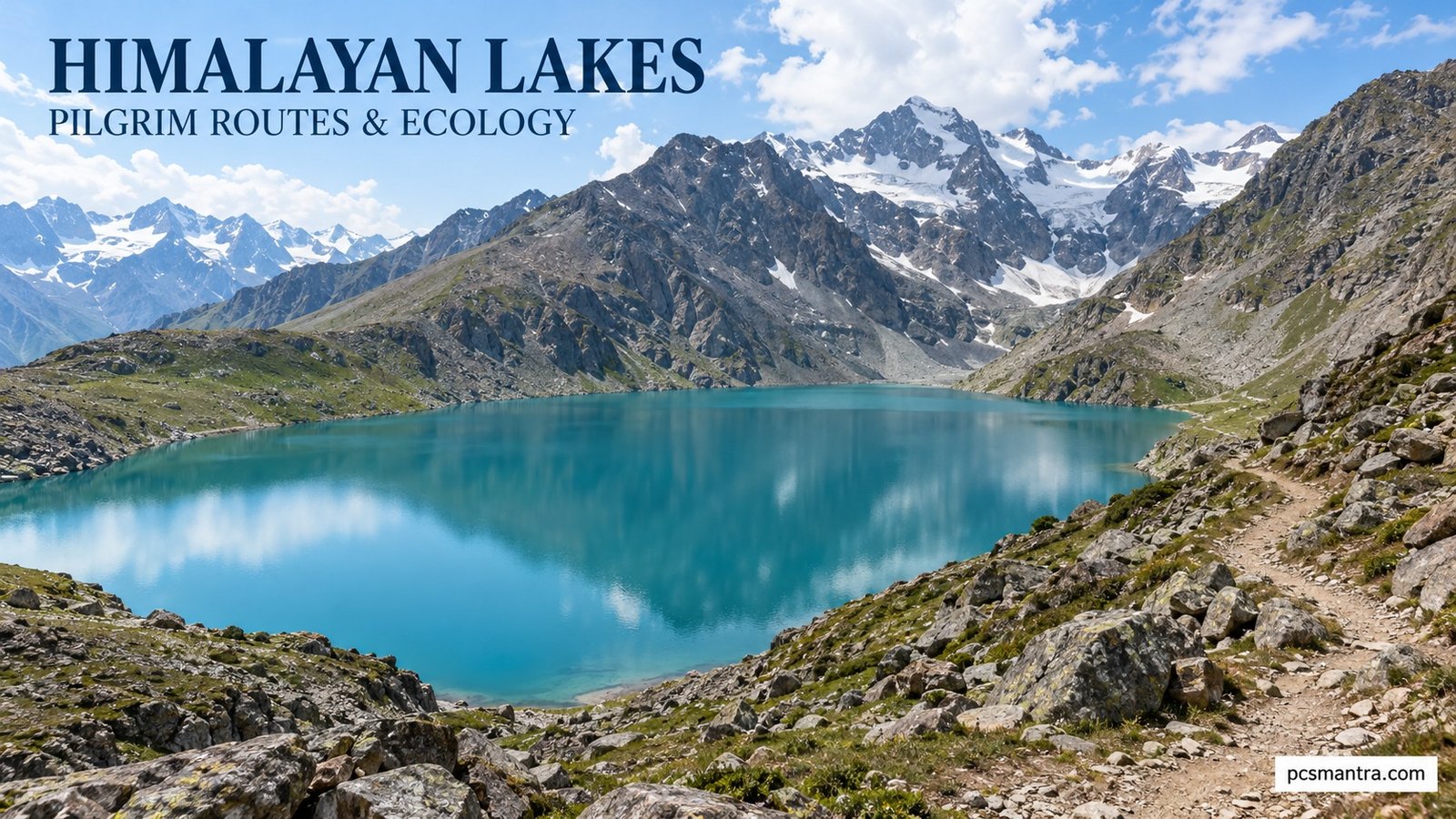
Location: according to the Anantnag district administration's tourism page, it is a high-altitude oligotrophic lake on the track to the Amarnath cave, known for its turquoise-green waters. [1]
Place on the pilgrim route: per the Shri Amarnathji Shrine Board, Sheshnag is actually a mountain whose seven peaks resemble the heads of the mythical snake, which gives it the name. The second night's camp of the yatra is at Sheshnag, overlooking the deep blue lake and glaciers beyond. From there pilgrims climb across the Mahagunas Pass at 4,276 m (about 14,000 ft) to reach Panjtarni. [2]
Size: one news report puts the lake at about 1.1 km long and 0.7 km wide, with the cave 18 to 20 km from the Sheshnag halt. These figures do not come from an official survey, so do not memorise them as firm numbers for the exam. [4]
Who said what in the controversy
BRO statement (23 November): BRO said it was carrying out post-Amarnath Yatra works in compliance with all applicable safety norms and environmental safeguards. It said that, given the experience of the previous yatra and the need for a wider road, it had begun widening tracks, focusing on stabilising vulnerable stretches. The statement said the works are confined to existing tracks and that measures are taken for safe disposal of excavated material, protecting natural drainage and minimising disturbance to surrounding terrain. BRO comes under the Ministry of Defence. [3]
J&K government position (25 November): the Forest Minister said that a 12-member team sent on the Chief Minister's direction, with officials from the Environment, Ecology and Territorial Forests divisions and the Forest Protection Force, found no tampering or violations. He also said the video is misleading and that there is a gap of 200 to 300 ft between the pilgrim track and the lake. He referred to the 2025 memorandum of understanding (MoU) between the state government and BRO's Project Beacon, and said the current track conforms to the 12-ft width ordered by the Supreme Court after a 2012 incident. [4]
Concerns: according to the reports, some political leaders, local people and environmental activists raised concern over the use of heavy machinery and asked for detailed scientific studies, environmental impact assessments and consultation with experts and local communities. They described the area as surrounded by loose slopes. One report also noted that BRO had not explained why machinery was being used in the high mountains. [3]
What is not established: the available sources contain no independent scientific assessment confirming damage to the lake, a violation of rules or a confirmed hazard. On the other side, the finding of the official team also appears only as the minister's statement; its full report is not in these sources. Keep the language of any conclusion on this controversy cautious.
Related concepts
Glacial lake: a lake formed by water collecting from melting glaciers, or in hollows and dams created by them.
Moraine: rocky debris carried and deposited by a glacier. It is often loose, so disturbing slopes made of it can carry a landslide risk. In the sources above a political leader described the area as surrounded by such slopes; this claim is not backed by an independent assessment.
GLOF (glacial lake outburst flood): a sudden flood when a glacial lake breaches or overflows. This is a general hazard concept. The sources do not confirm any GLOF risk at Sheshnag Lake.
Environmental impact assessment (EIA): a prior study of a project's likely environmental effects, on the basis of which it is cleared or conditions are imposed.
Border Roads Organisation (BRO): an organisation under the Ministry of Defence that builds roads in border and difficult areas.
Analysis for the exam
Development versus ecology: widening a pilgrim track can ease crowding and safety problems. At the same time, work in a fragile high-altitude ecosystem needs a firm scientific basis. Both can hold together, so the question is less "whether the work should happen" than "how it should happen".
Transparency: when information such as a video spreads fast and parties make different claims, publishing the project's scope, location and safeguards is the most direct way to reduce disputes.
Independent monitoring: trust grows if, alongside a government team's inspection, independent scientific institutions monitor the site and publish reports.
Map-based facts: for map questions, remember that Sheshnag is in Anantnag district, on the traditional Pahalgam route of the Amarnath Yatra, followed by the Mahagunas Pass and Panjtarni.
Way forward
Before any widening or construction on Himalayan pilgrim routes there should be independent scientific study, environmental assessment, consultation with local communities and monitoring during the work. Regulating pilgrim numbers, waste management and disaster preparedness matter just as much. Making project details and inspection reports public will leave less room for rumour.
Prelims practice question
Question 1. Consider the following statements regarding Sheshnag Lake:
Statement 1: It is a high-altitude oligotrophic lake in Anantnag district, on the track to the Amarnath cave.
Statement 2: On the traditional route, pilgrims cross the Mahagunas Pass after Sheshnag to reach Panjtarni.
Statement 3: The lake is located in Ganderbal district.
Which of the statements given above are correct?
Answer and explanation
Answer: (b).
Statement 1 is correct: per the district administration it is an oligotrophic lake in Anantnag district on the track to the Amarnath cave. Statement 2 is correct: per the Shrine Board, pilgrims cross the Mahagunas Pass after Sheshnag to reach Panjtarni. Statement 3 is incorrect: the lake is in Anantnag district.
Question 2. Which of the following statements about an oligotrophic lake is correct?
Answer and explanation
Answer: (b).
An oligotrophic lake has low nutrient levels, so biological productivity is limited and the water is usually clear. Very high nutrients and algal growth mark a eutrophic lake.
Mains practice question
Question 1. "Balancing infrastructure expansion with ecological conservation on Himalayan pilgrim routes is a major policy challenge today." Discuss in the context of the recent controversy near Sheshnag Lake. (250 words, 15 marks)
Answer outline
Introduction: A brief context of the controversy, noting that the claims of the parties are not independently verified; the dual role of Himalayan pilgrim routes (faith and fragile ecosystems).
Body: The need for pilgrim safety and ease of movement; the BRO and government position (works confined to existing tracks, no violation found in inspection); the demands of those raising concern (scientific study, EIA, consultation); measures such as transparency, independent monitoring and carrying-capacity limits.
Conclusion: Conclusion: development and conservation are not opposed, but in fragile regions an evidence-based and transparent process is what builds trust.
Sources
- https://anantnag.nic.in/touristplaces-modern/ (District Anantnag, Government of Jammu and Kashmir, tourist places)
- https://jksasb.nic.in/traditional_route.html (Shri Amarnathji Shrine Board, traditional route)
- https://indianexpress.com/article/india/bro-defends-excavator-work-sheshnag-lake-amarnath-yatra-kashmir-leaders-warn-disaster-10975452/ (Press report, 23-24 November 2026, BRO statement and reactions)
- https://www.thehindu.com/news/national/jammu-and-kashmir/no-tampering-violation-found-at-sheshnag-lake-jk-minister-altaf-kaloo/article71741828.ece (Press report, 25 November 2026, J&K Forest Minister on the official team inspection)
The news-based parts (use of machinery, the official team's finding, the concerns) rest on secondary reports and reflect the position up to 25 November 2026.
Frequently asked questions
Where is Sheshnag Lake?
In Anantnag district, Jammu and Kashmir, on the track to the Amarnath cave. The district administration describes it as a high-altitude oligotrophic lake.
What did BRO say?
In its 23 November statement BRO said it is carrying out post-yatra works in compliance with safety norms and environmental safeguards, that the works are confined to existing tracks, and that track widening aims to stabilise vulnerable stretches.
What did the government inspection team find?
According to the J&K Forest Minister, the 12-member team found no tampering or violations. This finding is not independently verified and the full report is not in these sources.
Has damage to the lake or a flood risk been proved?
The available sources contain no independent scientific finding to that effect. Concerns have been raised, but they are not confirmed assessments.
Download this article: PDF