
News reference: 27 November 2026
Published: 28 November 2026
Prelims: science and technology, nanocrystals and LEDs
In this article
Why in the news
A Department of Science and Technology release dated 27 November 2026 describes a technique to stabilise the colours of halide perovskite nanocrystals for white LEDs. Researchers at Bengaluru's Centre for Nano and Soft Matter Sciences (CeNS) and IIT Delhi used a dual-protection strategy. CeNS is an autonomous institute under the department.
This is the release date, not the paper's publication date. CeNS's publication list records the related study in Small, volume 22, e12820 (2026).
The problem: colour mixing through ion exchange
Nanocrystals are very small crystalline particles. The all-inorganic halide perovskites used here have the general formula CsPbX₃, where X can be chlorine, bromine or iodine. They can emit bright, pure colours.
When particles with different compositions come close, however, their halide ions can migrate and swap between crystals. This is anion exchange. Green-emitting CsPbBr₃ and red-emitting CsPbI₃ can then shift towards an intermediate orange colour instead of retaining their separate colours. That disrupts the balance needed for white light.
How the two protections work
First, reducing surface vacancies: The researchers used lead selenide to reduce halide vacancies on crystal surfaces. A vacancy is a site where an expected ion is missing. Such sites can provide a route for ion migration.
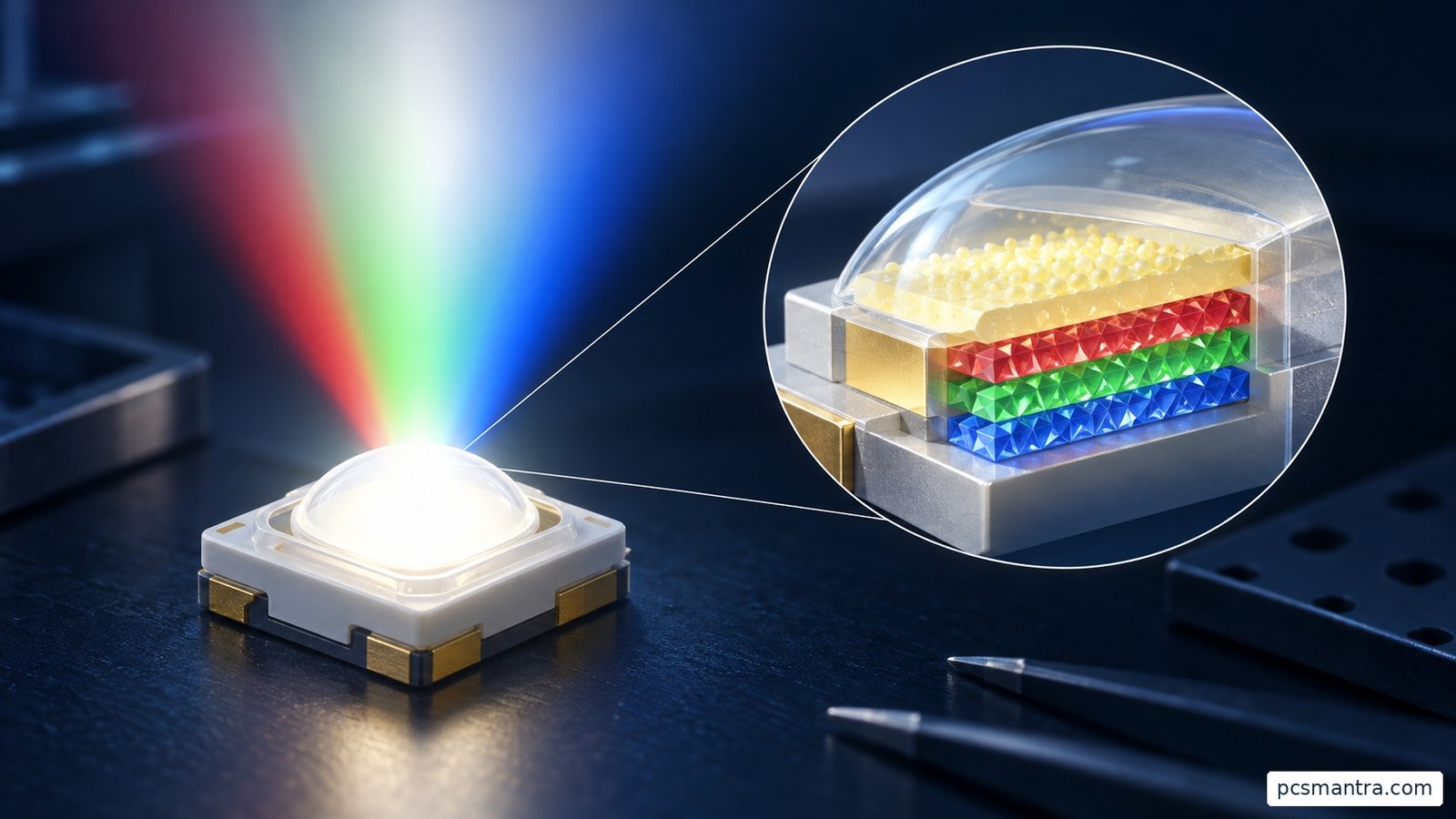
Second, a physical barrier: Atomic layer deposition (ALD), a technique for depositing very thin layers in a controlled manner, added a transparent 5-6 nanometre alumina (Al₂O₃) coating. It acts as a barrier to ion diffusion between adjacent colour-emitting layers.
One measure reduces migration pathways; the other separates layers with a barrier. The strategy should not be confused with simply mixing colours.
What the experiment establishes
Spray coating and micropatterning were used to build multilayer devices on glass and flexible PET plastic substrates. The release reports up to 24 hours of continuous operation for optimised versions, with stable white emission. Changing the electrical current could also alter the tone of the light.
This is a laboratory result, not a certified lifetime for a commercial LED. Lead toxicity and environmentally sound production still need attention. Cost, manufacturing at scale and long-term reliability must also be assessed separately from a laboratory demonstration.
Prelims practice question
Consider the following statements about this perovskite LED research:
Statement 1: Halide anion exchange can change the colours emitted by nanocrystals of different compositions.
Statement 2: A thin alumina layer acts as a physical barrier to ion diffusion.
Statement 3: A 24-hour laboratory test proves that lead toxicity has been eliminated for commercial use.
Which of the statements given above are correct?
(a) 1 only
(b) 1 and 2 only
(c) 2 and 3 only
(d) 1, 2 and 3
Answer and explanation
Correct answer: (b)
Statement 1 is correct: Anion exchange can produce unwanted colour shifts.
Statement 2 is correct: The ALD alumina layer obstructs ion diffusion.
Statement 3 is incorrect: Operating duration and toxicity are separate tests; the lead issue remains to be addressed.
Frequently asked questions
Was the paper published on 27 November?
This article does not make that claim. The date refers to the official news release.
Is 24 hours the product's full lifetime?
No. It is the reported operating duration of optimised laboratory devices.
Is the device lead-free?
No. The CsPbX₃ composition contains lead, and toxicity remains a challenge.
Sources
https://www.pib.gov.in/PressReleseDetailm.aspx?PRID=2342511&lang=2®=48
https://cens.res.in/en/faculty-en/pralay/journals
https://doi.org/10.1002/smll.202512820
Download this article: PDF