
News date: 26 November 2026 | Published: 26 November 2026
News context: Constitution Day (Samvidhan Diwas) is being observed on 26 November 2026 to mark the adoption of the Constitution by the Constituent Assembly on 26 November 1949. This year the Ministry of Parliamentary Affairs is facilitating an online reading of the Preamble on the MyGov portal in 23 languages (the 22 Scheduled Languages and English). [1]
Exam context: Prelims often tests the gap between 'adopted' and 'came into force', Article 394, and facts about the Constituent Assembly. In Mains these same facts form the base of any answer on how the Constitution was made.
Prelims: Constituent Assembly, commencement of the Constitution (Article 394), Constitution Day
Mains: General Studies II: Indian Constitution: historical underpinnings, evolution and features
In this article
Why in News
Constitution Day is being observed across the country on 26 November 2026. According to the official release, the day commemorates the adoption of the Constitution by the Constituent Assembly on 26 November 1949, and it has been observed as Constitution Day since 2015. [1]
The 2026 programme: The Ministry of Parliamentary Affairs is running an online reading of the Preamble on MyGov, where participants can take a certificate and share it. A Constitution Quiz runs on MyGov and MyBharat from 18 to 26 November 2026, and the Viksit Bharat Yuva Samvad is being held from 24 to 26 November in 786 districts across all 36 States and Union Territories. [1]
How Constitution Day began: the 2015 decision
In 2015 the Government decided to observe 26 November as 'Constitution Day'. That year the country was holding a year-long celebration of the 125th birth anniversary of Dr B. R. Ambedkar, and Constitution Day was presented as part of it. Dr Ambedkar chaired the Drafting Committee of the Constituent Assembly. [5] The Ministry of Social Justice and Empowerment was made the nodal ministry, and programmes such as reading the Preamble in schools, essay competitions and quizzes on the Constitution were planned. [2]
Three dates, three meanings
| Date | What happened | Source |
|---|---|---|
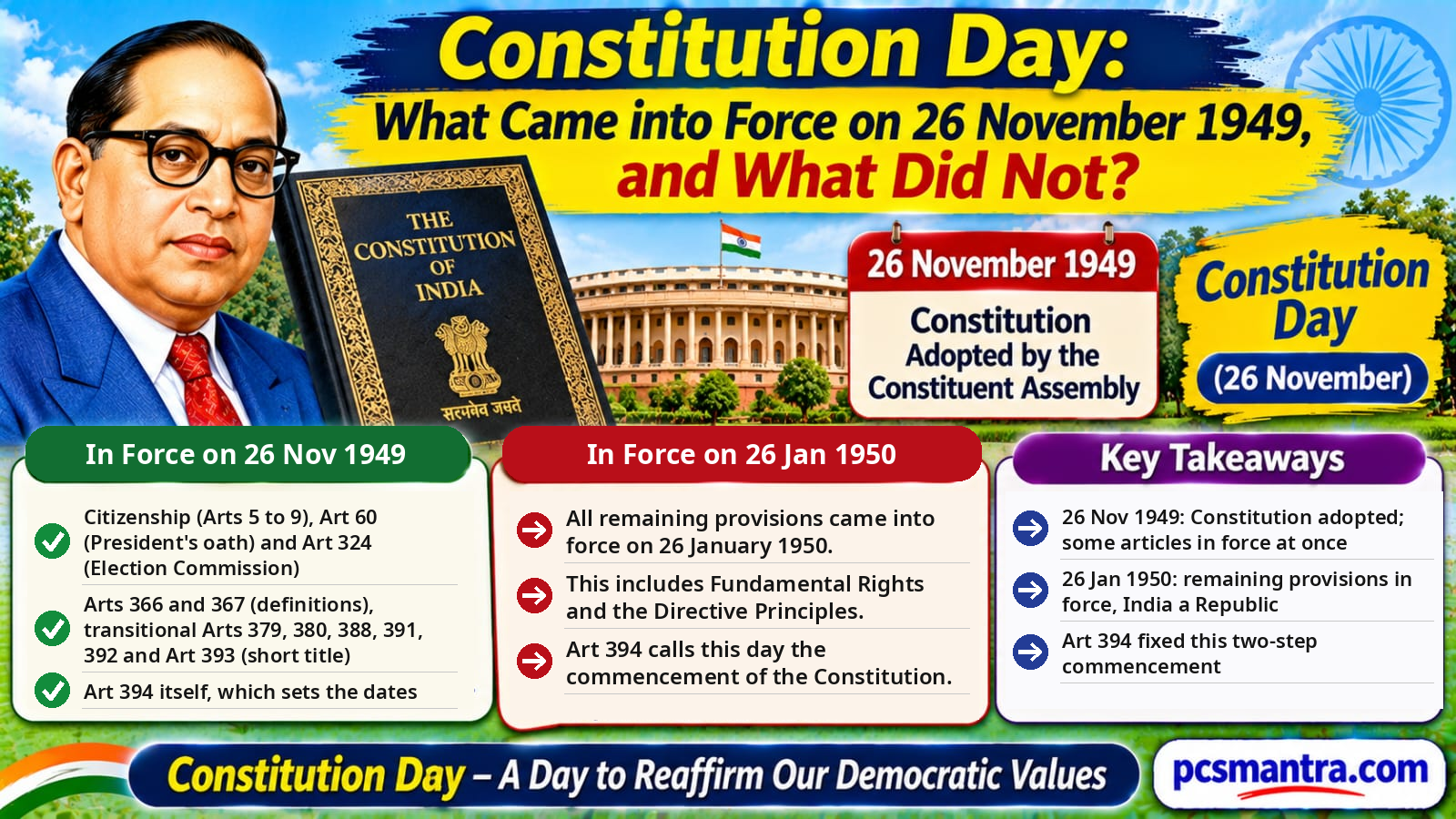
| 26 November 1949 | The Constituent Assembly adopted the Constitution. The articles listed in Article 394 came into force at once. | [1] [4] |
| 24 January 1950 | Last sitting of the Constituent Assembly. 284 members signed the Constitution, and Dr Rajendra Prasad's name was announced as the first President. | [3] |
| 26 January 1950 | The rest of the Constitution came into force. This is the 'commencement of the Constitution', observed as Republic Day. | [2] [4] |
Article 394: which provisions applied immediately
Article 394 deals with commencement. It says that this article and articles 5, 6, 7, 8, 9, 60, 324, 366, 367, 379, 380, 388, 391, 392 and 393 came into force at once, and the remaining provisions on 26 January 1950. [4]
The list covers citizenship (articles 5 to 9), the President's oath (Article 60), the Election Commission (Article 324), definitions and rules of interpretation (articles 366 and 367), other listed articles (379, 380, 388, 391 and 392) and the short title (Article 393). In examinations this fact is often turned into a wrong statement such as 'the entire Constitution came into force on 26 November 1949'.
Exam-ready facts about the Constitution
- Size: At commencement the Constitution had 395 Articles, 22 Parts and 8 Schedules. [3]
- Writing: The original was neither typeset nor printed. It was handwritten in calligraphy in both English and Hindi. [3]
- Artwork: The decoration was done by artists of Shantiniketan under Acharya Nandalal Bose, and the calligraphy by Prem Behari Narain Raizada. [3]
- Women members: The Constituent Assembly had 15 women members. [3]
- Drafting Committee: Dr Ambedkar was its Chairman. [5]
Way Forward
Constitution Day matters only if reading the Preamble turns into understanding: citizens should know what their rights, duties and the limits on institutions are. That is why the government stresses participation of students, youth and the grassroots this year. [1] The same approach helps in preparation: instead of memorising dates, understand what each stage meant constitutionally.
Prelims Practice Questions
Question 1. Consider the following statements:
Statement 1: Constitution Day is observed on 26 November to commemorate the adoption of the Constitution by the Constituent Assembly.
Statement 2: The practice of observing it as Constitution Day began in 2015.
Statement 3: It is the day on which the entire Constitution came into force.
Which of the statements given above are correct?
Answer and explanation
Answer: (a)
Statement 1 is correct: the Constituent Assembly adopted the Constitution on 26 November 1949. [1]
Statement 2 is correct: the day has been observed as Constitution Day since 2015. [1] [2]
Statement 3 is incorrect: the whole Constitution came into force on 26 January 1950. Under Article 394 only certain articles came into force on 26 November 1949. [4]
Question 2. Consider the following two statements:
Statement-I: Some provisions of the Constitution came into force on 26 November 1949 itself.
Statement-II: Under Article 394, articles 5, 6, 7, 8, 9, 60, 324 and others came into force at once, and the rest of the Constitution on 26 January 1950.
Which one of the following is correct in respect of the above statements?
Answer and explanation
Answer: (a)
Statement-I is correct: the provisions listed in Article 394 came into force with the adoption of the Constitution. [4]
Statement-II is correct and it is the basis of Statement-I: Article 394 lists the articles that applied at once and fixes 26 January 1950 for the rest. [4]
Question 3. With reference to the Constituent Assembly and the making of the Constitution, consider the following statements:
Statement 1: 284 members of the Constituent Assembly signed the Constitution on 24 January 1950.
Statement 2: The original Constitution was not typeset or printed but handwritten in calligraphy.
Statement 3: The Constituent Assembly had 15 women members.
Which of the statements given above are correct?
Frequently Asked Questions (FAQ)
When and why is Constitution Day observed?
Constitution Day is observed every year on 26 November to remember the adoption of the Constitution by the Constituent Assembly in 1949. It has been observed as Constitution Day since 2015. [1] [2]
Did the Constitution come into force on 26 November 1949?
Not entirely. Under Article 394 only articles 5, 6, 7, 8, 9, 60, 324, 366, 367, 379, 380, 388, 391, 392, 393 and Article 394 itself came into force at once. The rest came into force on 26 January 1950. [4]
What is the difference between Constitution Day and Republic Day?
Constitution Day (26 November) remembers the adoption of the Constitution, while Republic Day (26 January) remembers the day the Constitution came fully into force. [2] [4]
What is special about Constitution Day 2026?
An online reading of the Preamble on MyGov in 23 languages, a Constitution Quiz from 18 to 26 November, and the Viksit Bharat Yuva Samvad in 786 districts from 24 to 26 November. [1]
Sources
- [1] PIB, Constitution Day, 2026 to be observed on 26th November (25 Nov 2026): https://www.pib.gov.in/PressReleasePage.aspx?PRID=2341449&lang=2®=48
- [2] PIB (Ministry of Social Justice and Empowerment), 26th November to be observed as 'Constitution Day' (23 Nov 2015): https://www.pib.gov.in/newsite/PrintRelease.aspx?lang=2®=48&relid=131806
- [3] PIB Factsheet, Constitution of India (Interesting Facts) (25 Nov 2021): https://www.pib.gov.in/FactsheetDetails.aspx?Id=148584&lang=1®=3
- [4] Constitution of India, Article 394 (Commencement): https://www.constitutionofindia.net/articles/394-commencement/
- [5] Supreme Court of India, Dr B. R. Ambedkar's Speeches in the Constituent Assembly: https://api.sci.gov.in/AMB/Speech.php
Download this article: PDF